 Vanitiro Editorial Team
Iran has already done much of the hardest work. It has stockpiled 7,154 kg of 3.5% low-enriched uranium, and that stockpile alone could yield material for 6 nuclear weapons, while representing roughly 70% of the enrichment effort needed to reach weapons-grade material, according to United Against Nuclear Iran's breakdown. That single fact reframes the iran nuclear threat. The issue isn't only whether Tehran has decided to build a bomb. It's how much technical advantage it has accumulated before that decision.
That influence shapes far more than nonproliferation debates. It affects Israeli military planning, Gulf deterrence strategies, sanctions design, shipping risk in the Gulf, and the oil market's sensitivity to every strike, seizure, or inspection dispute. A program once discussed as a distant strategic concern now sits at the center of a live crisis where engineering details and market consequences are tightly linked.
The central policy problem is straightforward. Iran's program creates a condition of strategic ambiguity that is dangerous precisely because it falls short of overt weaponization. It gives Tehran coercive value, bargaining power, and a deterrent shadow, while forcing its adversaries to decide whether to tolerate latency or risk war to prevent it.
Table of Contents
- The Enduring Center of a Global Crisis
- Understanding Iran's Current Nuclear Capabilities
- Timeline of Recent Nuclear Escalations
- Iran's Strategic Motivations and Calculations
- Regional and Global Security Implications
- Gauging the Economic and Market Impacts
- Diplomatic Pathways and Escalation Scenarios
The Enduring Center of a Global Crisis
Missile exchanges, proxy clashes, tanker incidents, and sanctions votes dominate headlines. But they're often secondary effects. The core driver is the nuclear file, because only the nuclear issue can simultaneously alter military doctrine, alliance behavior, sanction architecture, and energy pricing.
Iran's nuclear program matters because it converts a regional power struggle into a system-level problem. A conventional confrontation can remain bounded. A state with advanced enrichment capacity, buried facilities, and the ability to compress decision time forces outside powers to plan for worst cases. That's what turns the iran nuclear threat into a global crisis rather than a recurring Middle East dispute.
Three implications follow.
- For security planners: the key question isn't whether Iran is weaponizing. It's whether its capability has reached a point where warning time is too short for diplomacy or military intervention to work cleanly.
- For diplomats: the challenge isn't only getting Iran back into compliance. It's rebuilding a verification framework after repeated escalation and after strikes have changed the physical layout of the program.
- For markets: the issue isn't just war risk. It's whether nuclear uncertainty increases the probability of disruptions in the Gulf and changes the sanctions outlook.
Bottom line: A near-threshold nuclear program exerts pressure even without a declared bomb. It changes behavior in Washington, Jerusalem, Riyadh, and energy trading desks long before any warhead exists.
That's why technical details matter. Uranium percentages, centrifuge models, and underground infrastructure sound specialized, but they are the operational language of risk. Once those variables move, military options narrow, diplomacy becomes more urgent, and investors begin pricing in disruption.
Understanding Iran's Current Nuclear Capabilities
Iran's program now sits in a zone where technical capacity carries immediate strategic and economic consequences. The issue is not only how much uranium Iran has produced. It is how stockpiles, centrifuges, and hardened facilities interact to shorten warning time, complicate military planning, and raise the probability of sanctions and energy market disruption.
The Meaning of Iran's Stockpiles
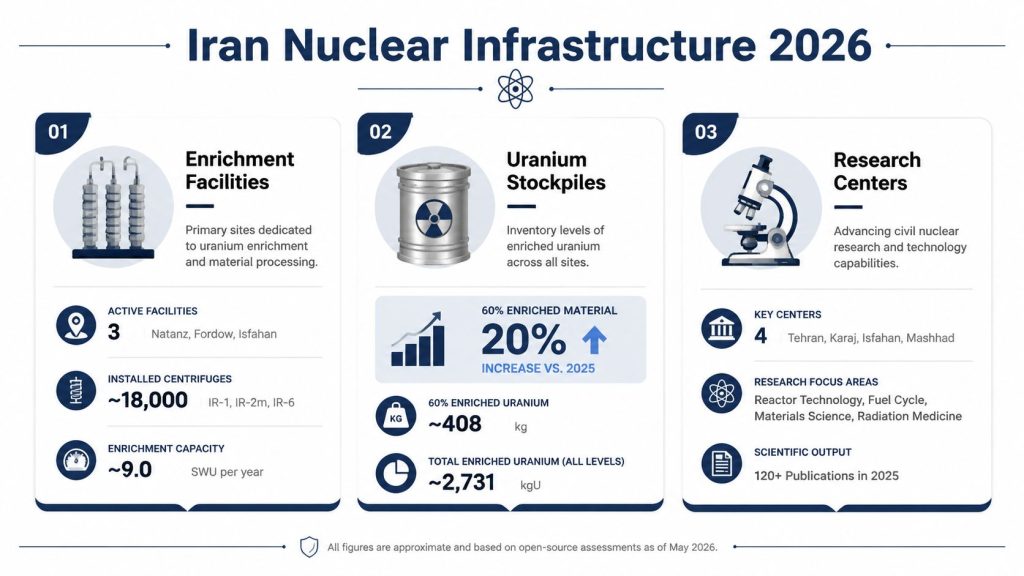
Iran's accumulated low-enriched uranium matters because enrichment is cumulative. Material enriched to 3.5 percent is still far from weapons-grade, but it has already passed through the most time- and machine-intensive early stage of the process. That changes the policy problem. A large stockpile of low-enriched uranium gives Tehran optionality, since feedstock that already exists can be pushed higher faster than natural uranium can be enriched from scratch.
That is why analysts treat different enrichment levels differently.
| Material stage | Why it matters |
|---|---|
| 3.5% LEU | Large volumes reduce the work required for further enrichment |
| 20% material | This goes well beyond ordinary civilian fuel use and signals a more advanced nuclear posture |
| 60% material | This is close enough to weapons-grade to compress breakout timelines sharply |
The non-obvious point is financial as much as technical. Markets do not wait for a bomb test. They react when the stockpile profile suggests less diplomatic time, a higher chance of coercive action, and greater risk to Gulf shipping and sanctions enforcement.
Facility geography compounds that risk. Iran's program is distributed across sites including Fordow and Natanz, and Fordow's underground design matters because buried infrastructure is harder to destroy and easier to preserve under pressure. A protected enrichment site changes the military equation even if no final decision to weaponize has been made.
Why centrifuges matter as much as uranium
Stockpiles set the base. Centrifuges set the pace.
Iran's installed centrifuge base gives it the capacity to convert existing material into higher-enriched product far faster than a stockpile number alone would suggest. The practical question for policymakers is not just how much uranium exists today, but how much separative work Iran can generate if more machines are activated or reconfigured.
Advanced centrifuges increase that risk further. At Fordow, the use of IR-6 cascades to feed 20% enriched uranium into production lines for 60% material has drawn particular scrutiny, according to the Arms Control Association's summary of the program's status. Richer feedstock and faster machines reinforce each other. That combination compresses timelines more than either factor would on its own.
Practical rule: Watch the combination. A stockpile without processing capacity is limited. Centrifuges without feedstock are constrained. Protected sites holding both create the primary threat.
The term breakout time is often misunderstood. In policy use, it refers to the time needed to produce enough fissile material for one weapon, not the time required to field a deliverable nuclear device. That distinction matters because governments and markets respond to the first threshold well before the second. Once breakout time becomes short, military options become riskier, diplomacy becomes more urgent, and the economic cost of miscalculation rises.
Timeline of Recent Nuclear Escalations
The recent escalation cycle matters because it changed both the physical condition of Iran's program and the political assumptions around it. What was once a contest of inspections, breaches, and sanctions became a direct military confrontation.

From pressure to direct strikes
In June 2025, Israel launched strikes that severely damaged Iran's nuclear and military sites. In February 2026, a larger joint U.S.-Israel offensive followed, aimed at destroying nuclear and missile capabilities. Iran then retaliated with approximately 530 ballistic missiles and over 1,000 drones on Israel, plus 14 missiles on the U.S. Al Udeid air base, according to the Institute for Science and International Security timeline and assessment.
Those events did more than widen a conflict. They erased any remaining separation between the nuclear file and regional war planning. Once nuclear facilities become direct military targets, every subsequent enrichment move is interpreted through a wartime lens. Every retaliatory strike then feeds the argument that Iran needs greater deterrent capacity.
A short chronology makes the pattern clear:
- Nuclear advancement increased alarm. Iran's stockpiles and enrichment profile deepened concern that it was approaching an intolerable threshold.
- Israel acted militarily. The initial strikes were designed to degrade both nuclear and military infrastructure.
- The United States joined a larger offensive. That widened the confrontation and tied Washington more directly to the physical suppression of Iran's program.
- Iran answered with large-scale retaliation. The conflict became regional, not bilateral.
Why the escalation cycle hardened
This cycle is now self-reinforcing. Military action can degrade infrastructure, but it also hardens threat perception on all sides. Tehran can point to strikes as proof that it needs a stronger deterrent position. Israel can point to Iran's retained capability as proof that preventive action wasn't decisive enough. Washington then faces the familiar dilemma of whether to press for de-escalation or reinforce coercion.
The central lesson of 2025 and 2026 is that the nuclear issue is no longer insulated from battlefield logic. It now sits inside it.
That shift makes diplomacy harder. Trust was already thin after earlier breaches and sanctions disputes. Direct attacks on critical facilities reduce it further because they create incentives for concealment, redundancy, and dispersed recovery efforts. For policymakers, the important takeaway isn't that escalation happened. It's that the operational environment around the iran nuclear threat is now more militarized, less transparent, and more prone to sudden shifts.
Iran's Strategic Motivations and Calculations
Iran's nuclear strategy is often reduced to a yes-or-no question about bomb building. That misses the regime's more useful position. Tehran gains an advantage from being advanced enough to frighten its adversaries, but ambiguous enough to avoid crossing every line at once.
Deterrence without declaration
A threshold capability serves several purposes for the Iranian state. It strengthens deterrence against external attack. It reinforces regime prestige at home and in the region. It also gives Tehran negotiating currency by making sanctions relief and diplomatic concessions more valuable to outside powers.
The strategic logic is cold but coherent. If Iran can maintain an advanced enrichment base without openly weaponizing, it forces others to bear the burden of escalation. Israel must decide whether to strike again. The United States must decide how much pressure it can apply without pushing Tehran toward a final decision. Gulf states must prepare for both deterrence failure and diplomatic reversal.
This posture is especially potent because it doesn't require Tehran to announce a weapons program. It only requires enough capability to make that possibility credible.
Why ambiguity is useful to Tehran
Recent probabilistic models estimate a 40-50% chance Iran will ultimately decide to build nuclear weapons, with the odds of success within 5-6 months of that decision rising to 34-42%. Those figures, cited in the earlier escalation analysis, matter less as prediction than as evidence of how uncertainty itself has become a strategic asset.
Iran benefits from three layers of ambiguity:
- Intent ambiguity. It can say it isn't building a bomb now.
- Timeline ambiguity. Adversaries can't be sure how much warning time they would have after a political decision.
- Capability ambiguity. Damage assessments after strikes remain imperfect, especially around buried or dispersed assets.
Analytic takeaway: Tehran doesn't need certainty to gain leverage. It needs its rivals to fear they're running out of time.
That helps explain Iran's risk tolerance. A state pursuing pure civilian nuclear energy wouldn't need this level of opacity, this degree of enrichment sensitivity, or this much strategic signaling around protected infrastructure. Iran's posture suggests that the program functions as a hedge, a bargaining chip, and a deterrent reserve all at once. For outside governments, that means pressure alone won't settle the issue. The program serves too many purposes for Tehran to surrender it cheaply.
Regional and Global Security Implications
The iran nuclear threat doesn't stop at Iran's borders. It alters the security calculations of nearly every major actor connected to the Middle East, from Israel and the Gulf monarchies to Washington, Moscow, Beijing, and European capitals.

Israel and the doctrine of prevention
For Israel, a capable Iranian threshold program is treated as an unacceptable long-term condition. That's why preventive force remains central to Israeli planning. The issue isn't whether Iran has a finished weapon today. It's whether Israel believes the margin for stopping one is closing.
This logic doesn't remain confined to bilateral confrontation. It affects regional military posture, missile defense demand, and intelligence cooperation across the Gulf. It also raises the chance that local crises can trigger wider conflict if they're interpreted as cover for nuclear acceleration.
Readers tracking Gulf flashpoints should view Vanitiro's Strait of Hormuz clash coverage through that lens. Maritime tension and nuclear anxiety often interact. Each can amplify the other even when they begin as separate incidents.
The wider nonproliferation cost
For Arab Gulf states, the danger is strategic imbalance. If Iran retains a durable near-threshold capability, neighbors will question whether existing security guarantees are enough. Even without a formal regional arms race, the incentive to seek stronger hedging tools grows.
For the United States, the challenge is layered:
| Actor | Core concern |
|---|---|
| United States | Preventing weaponization without being pulled into open-ended war |
| Gulf states | Avoiding coercion from a stronger Iran while protecting energy infrastructure |
| Europe | Containing proliferation and energy disruption at the same time |
| Russia and China | Managing instability while using the crisis to complicate U.S. influence |
The broader cost is institutional. Once a state demonstrates that it can approach the threshold, absorb strikes, preserve parts of its infrastructure, and remain central to diplomacy, the global nonproliferation regime looks less decisive. That weakens deterrence elsewhere. Other governments learn that ambiguity, dispersal, and underground protection can preserve strategic options even under pressure.
Gauging the Economic and Market Impacts
Oil does not wait for weaponization. Prices move earlier, when traders see a higher chance of sanctions tightening, shipping disruption, or military action around energy infrastructure.

Why nuclear timelines move oil markets
The key market question is not whether Iran has crossed a formal nuclear threshold. It is whether the program’s technical condition shortens or lengthens the window for a crisis decision. A shorter breakout timeline raises the odds of preemptive action, harsher sanctions, and shipping risk in the Gulf. A longer timeline gives governments more room to manage the issue through inspections, pressure, and limited diplomacy. That difference feeds directly into crude prices, tanker insurance, and risk assets tied to Middle East stability.
The economic effect is therefore indirect but immediate. Nuclear advances do not remove barrels from the market on their own. They change expectations about what states may do next. If investors judge that enrichment gains are outpacing monitoring and diplomacy, they start pricing the possibility of disruption before any missile is fired.
Physical damage to the program can produce the opposite effect for a time. According to NTI’s analysis of the post-war nuclear situation, the 2025 strikes degraded Iran’s nuclear supply chain and cut centrifuge production by an estimated 70-80%. NTI argues that this has reduced the short-term link between Iran’s nuclear progress and oil-price volatility, easing part of the nuclear risk premium in energy markets during 2026.
That matters for policy. A damaged program can lower near-term market stress even as the broader confrontation remains unresolved. Investors are effectively pricing capability restoration, not just hostile rhetoric. For readers tracking that overlap, Vanitiro’s reporting on U.N. sanctions and Hormuz shipping risk is useful because the sanctions channel and the maritime channel now reinforce each other.
What investors and policymakers should watch
A more useful framework is to separate political noise from changes that affect Iran’s ability to rebuild sensitive capacity.
Key watchpoints include:
- Facility recovery: Restoration of enrichment equipment or centrifuge production would likely raise the nuclear risk premium faster than another round of public threats.
- Inspection access: Reduced visibility makes worst-case assumptions more likely in both policy planning and commodity pricing.
- Hormuz-linked signaling: Maritime threats turn a nuclear dispute into a direct commercial risk for shipping, insurance, and energy supply chains.
- Sanctions coordination: Markets react more sharply when U.S., European, and U.N. pressure points align rather than fragment.
Markets price Iran’s capacity to recover sensitive nuclear activity faster than they price official statements.
For policymakers, the dilemma is straightforward. Actions that slow the program can calm markets in the short run. The same actions can increase medium-term uncertainty if they reduce transparency, complicate inspections, or push more of the program into harder-to-monitor channels. That is the economic meaning of the iran nuclear threat. Breakout time is not only a technical metric. It is also a measure of how much warning energy markets, insurers, and governments believe they still have.
Diplomatic Pathways and Escalation Scenarios
The most important shift in the current debate is that physical access now matters as much as stockpile size. A program can be dangerous on paper yet constrained in practice if critical material is buried, blocked, or too exposed to recover quickly.
A narrower diplomatic opening
A critical and underreported factor is that Iran has failed to access over 400 kg of its 60% enriched uranium, buried under rubble by strikes in 2025. According to defense-source reporting summarized in the cited assessment on buried uranium recovery, recovering this material could take years and cost over $500M, shifting the breakout debate from weeks to a much longer and more monitorable timeline.
That changes the diplomatic map. It doesn’t eliminate the iran nuclear threat. It does create a different kind of problem. If Iran can’t readily exploit some of its most sensitive material, outside powers may have more time to negotiate limited arrangements focused on monitoring, access, and recovery constraints rather than demanding an all-encompassing grand bargain at once.
One practical route would be a narrower deal built around inspections, non-expansion commitments, and technical containment. That wouldn’t solve every issue. It could, however, reduce the chance that miscalculation drives a new round of strikes.
For readers tracking that possibility, Vanitiro’s analysis of a possible one-page U.S.-Iran diplomatic deal captures the logic of a smaller, politically survivable arrangement better than maximalist frameworks do.
The path back to wider war
The alternative path is easier to imagine and harder to control. If Iran accelerates reconstruction, reduces monitoring, or uses missile and regional pressure to compensate for nuclear setbacks, Israel may conclude that another preventive campaign is necessary. If the United States becomes directly tied to that campaign again, escalation could spread quickly.
The most important signposts are qualitative, not statistical:
- Whether inspectors regain reliable visibility
- Whether buried material remains inaccessible
- Whether Iran emphasizes deterrent signaling over negotiation
- Whether Washington prioritizes containment or coercive rollback
A damaged program doesn’t automatically produce peace. It produces a window. What states do with that window determines whether diplomacy resumes or war expands.
The core conclusion is sobering but not fatalistic. Iran’s capabilities remain serious. Its strategic incentives remain mixed. Yet recent damage and recovery obstacles appear to have lengthened the timeline in at least one essential area. That gives diplomacy a narrower but more realistic opening than the public debate often suggests.
Vanitiro tracks exactly this intersection of security, diplomacy, sanctions, and market fallout. If you want concise, evidence-based coverage that connects nuclear developments to shipping risk, elections, and energy pricing, follow Vanitiro.