 Vanitiro Editorial Team
A tanker desk in the Gulf doesn't need a seminar on ideology to know when the risk map has changed. It needs to know whether a political shock in Tehran or Washington is about to raise sanctions exposure, reroute cargo, or put the Strait of Hormuz back at the center of pricing.
Table of Contents
- An Introduction to 70 Years of Conflict and Diplomacy
- From Alliance to Adversity 1953-1979
- Revolution Hostages and a New Cold War 1979-2002
- The Nuclear Standoff and the JCPOA Accord 2002-2015
- JCPOA Collapse and Maximum Pressure 2018-2024
- Direct Conflict and Strategic Shifts 2025-Present
- Key Themes and the Outlook for US-Iran Relations
An Introduction to 70 Years of Conflict and Diplomacy
A tanker insurer reprices Gulf exposure after a threat in the Strait of Hormuz. A refinery recalculates crude sourcing. A sanctions team reviews whether a new designation changes payment risk. Those decisions often trace back to the same bilateral history.
The Iran US relations timeline matters because this is not only a political dispute. It is a long-running contest over coercive tools, nuclear thresholds, maritime pressure, and the costs each side can impose on the other. The practical effect shows up in sanctions architecture, oil flows, shipping insurance, and force posture across the Gulf.
The modern rupture took shape after Iran's 1979 political transformation and the hostage crisis that followed. Iran held 52 U.S. diplomats and citizens for 444 days, and Washington severed diplomatic relations in April 1980. The break did more than end formal ties. It removed the direct channel that can contain escalation, making later crises harder to signal, harder to limit, and more likely to spill into markets.
That institutional break still structures policy.
For Washington, Iran strategy has usually combined three instruments: economic pressure, military deterrence, and narrow diplomatic engagement when the costs of deadlock rise. For commercial actors, those same instruments determine whether a headline remains political theater or turns into a compliance problem, a freight premium, or a supply disruption.
A more useful way to read the timeline is through three recurring mechanisms:
- Sanctions as a cumulative system. U.S. restrictions on Iran were built in layers over decades, which means each crisis rarely starts from zero. Policy choices usually tighten, reinterpret, or selectively waive an existing framework.
- Nuclear negotiations as risk pivots. Diplomatic openings gain traction when enrichment limits, verification, and sanctions relief are linked in terms both sides can test and enforce.
- The Strait of Hormuz as a pressure point. Tension with Iran repeatedly reaches the maritime domain because Gulf energy exports, naval patrol patterns, and commercial shipping routes sit close to the dispute's center of gravity.
The analytical mistake is to separate diplomacy from market structure. In this case, they are tightly connected.
That is why a historical timeline remains operationally relevant. A covert intervention in the 1950s, regime change in the 1970s, a nuclear agreement in 2015, and direct strikes in 2025 all feed the same present questions: how sanctions risk will change, whether energy markets will price a disruption premium, and how shipping firms will judge transit security. For readers tracking the current state of formal ties, Iran diplomatic relations offers a useful companion lens. The larger pattern is clear. This is an adaptive conflict system, not a static rivalry.
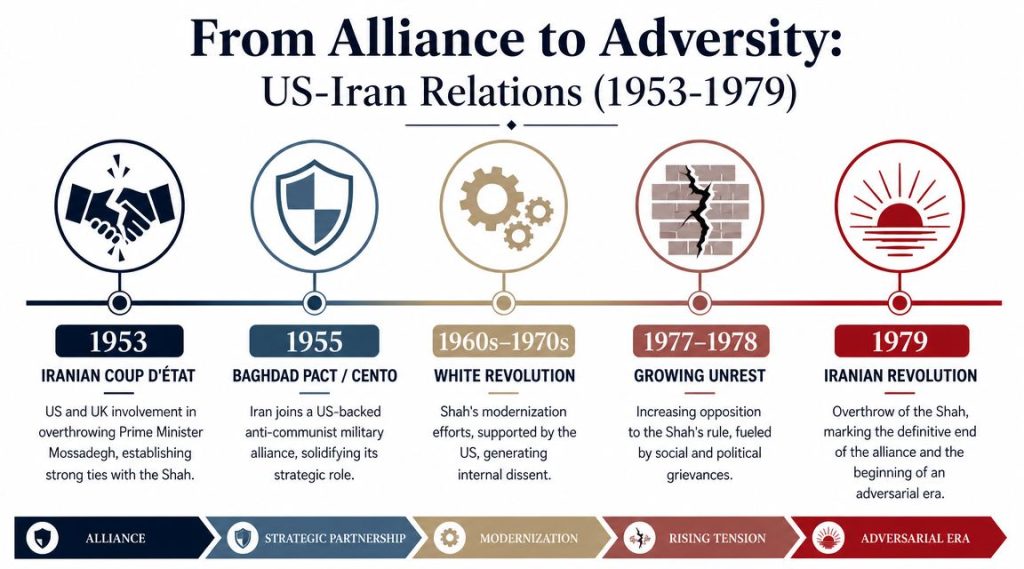
From Alliance to Adversity 1953-1979
A covert operation in Tehran did more than change a government. It altered how Iranian elites, energy planners, and later leaders of the new order would interpret U.S. power for decades.
In 1953, a CIA and MI6 backed coup removed Prime Minister Mohammad Mosaddegh and restored Shah Mohammad Reza Pahlavi. For Washington, the result looked strategically efficient. Iran remained aligned with the West, sat on the Soviet periphery, and occupied a position tied closely to Gulf oil flows and the maritime approaches that would later make the Strait of Hormuz a recurring pressure point.
The alliance Washington built
The post-1953 relationship rested on a clear Cold War bargain. The United States supplied military assistance, political backing, and economic support. Iran under the Shah helped anchor a pro-U.S. order near the Soviet Union and along the Gulf energy corridor.
That alignment had real strategic value. It reduced uncertainty for Western planners, supported a favorable regional balance, and strengthened the security environment around oil production and export routes. For markets, this was the appearance of stability. For Iranian domestic politics, it was a growing liability.
The contradiction was structural, not temporary.
A partnership that improves external security can still weaken internal legitimacy. In Iran, that is what happened. The monarchy gained foreign backing and coercive capacity, but many Iranians increasingly viewed the state as dependent on outside support and insulated from domestic accountability.
| Strategic layer | U.S. objective | Long-term risk created |
|---|---|---|
| Security alignment | Contain Soviet influence through a reliable regional partner | The Shah came to be seen by opponents as protected by Washington |
| Energy security | Preserve a favorable Gulf oil environment | Oil politics fused with nationalism and sovereignty grievances |
| State control | Back a centralized, predictable partner | Opposition hardened against both the monarchy and its foreign sponsors |
The alliance carried a sanctions lesson before sanctions existed
This period predates the modern sanctions regime, but it helps explain how that regime would later be received in Tehran. Iranian leaders after 1979 did not treat U.S. pressure as a narrow policy tool. They treated it as part of a longer pattern of intervention, coercion, and attempts to shape Iran's internal order.
That matters for risk analysis now. Sanctions do not operate in a political vacuum. Their effectiveness depends partly on whether the target sees relief as credible and pressure as limited, or sees both as instruments of regime pressure. The roots of that skepticism were planted during the alliance era.
Why the pre-1979 period still matters for energy and shipping risk
Analysts often treat the years before the revolution as background. They are more than that. This was the period in which Iran's relationship with the United States became linked to three issues that still drive risk pricing today: control over oil revenue, the security architecture of the Gulf, and the strategic use of geography near Hormuz.
By the late Shah period, Washington had a capable partner. It also had mounting exposure to a single ruler whose domestic position was deteriorating. That is a poor foundation for long-duration regional policy. Once legitimacy weakens, external support can preserve a government for a time, but it also widens the backlash if the system breaks.
The main conclusion is straightforward. 1953 produced short-term geopolitical order at the cost of long-term strategic fragility. The later rupture was not an isolated shock. It emerged from an alliance structure that protected U.S. interests in the moment while storing future risk in Iran's political system, in regional energy security, and eventually in the sanctions architecture that followed.
Revolution Hostages and a New Cold War 1979-2002
The break came fast. A new Islamic government took power in Tehran, militants seized the U.S. Embassy, and a bilateral dispute hardened into a security framework that still shapes sanctions design, oil risk premiums, and military signaling in the Gulf.
The core facts are established. Iran held 52 U.S. diplomats and citizens for 444 days, and Washington cut diplomatic relations in April 1980. That rupture did more than end an alliance. It removed the normal tools states use to contain crises, then replaced them with sanctions, intermediaries, covert contacts, and periodic shows of force.
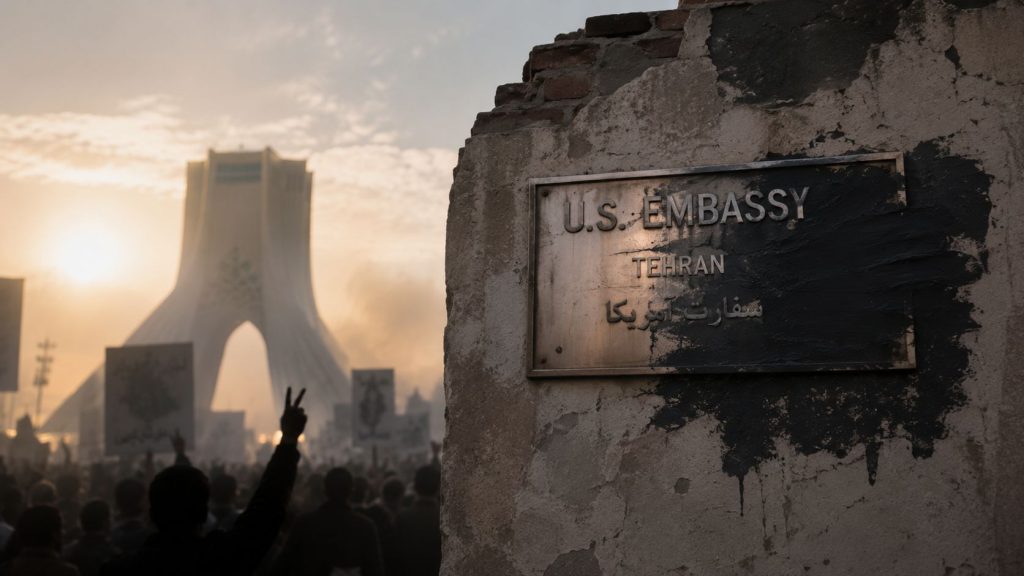
The hostage crisis remade the policy framework
After 1979, U.S. policy toward Iran was no longer organized around partnership. It was organized around pressure and risk containment. That shift mattered because sanctions became a standing instrument rather than a temporary response, and military signaling in the Gulf took on greater weight as direct diplomacy disappeared.
The strategic effect was cumulative. Each later incident was interpreted through the memory of the hostage crisis, which narrowed political room for compromise in Washington and gave anti-U.S. resistance a central place in the Islamic Republic's identity.
Three consequences followed.
- Diplomatic estrangement. Without embassies or routine senior contact, even limited incidents carried higher escalation risk.
- Sanctions architecture. The political foundation for long-duration U.S. economic restrictions was set during this period and expanded over time.
- Market sensitivity. Because the relationship lacked reliable channels, traders and policymakers had to price in miscalculation risk, especially around Gulf shipping and Hormuz transit.
Why the 1980s mattered for energy and maritime security
The Iran-Iraq War pulled the relationship into a broader contest over Gulf order. Oil infrastructure, tanker traffic, and external naval presence became part of the conflict environment. That changed the practical meaning of U.S.-Iran tensions. The issue was no longer only bilateral hostility. It was the security of energy flows through one of the world's most exposed maritime chokepoints.
This period established a pattern that still matters for risk analysis. Iran could not match U.S. power conventionally, but it could impose costs indirectly through shipping threats, regional proxies, and calibrated disruption. Washington, in turn, relied on naval presence, partner coordination, and economic pressure to limit that coercive space.
The 1988 downing of Iran Air Flight 655 reinforced the Iranian view that U.S. force in the Gulf could be both dominant and dangerous. The Iran-Contra affair sent a different but equally important signal. Limited transactions were possible even during open hostility, yet tactical contact did not produce strategic trust. For sanctions policy, that was a lasting lesson. Narrow bargains could happen, but neither side assumed they would change the structure of the conflict.
With formal diplomacy gone, bargaining survived only in fragments. That raised the value of coercive signals and lowered confidence that any limited accommodation would hold under stress.
The 1990s turned hostility into a durable system
By the post-Cold War period, the relationship had become self-sustaining. Sanctions policy widened, Gulf security remained militarized, and Iranian support for regional armed partners kept reinforcing the U.S. case for containment.
The 1990s are often treated as an interval between larger crises. Strategically, they were the consolidation phase. Washington refined the legal and financial tools that later made sanctions more scalable. Tehran refined asymmetric methods that later made deterrence in the Gulf more ambiguous and more expensive to enforce.
That combination had direct commercial implications. Energy firms, insurers, and shipping operators were not reacting only to diplomatic rhetoric. They were assessing a maturing confrontation in which legal exposure, cargo risk, and naval incidents increasingly overlapped.
A short comparison clarifies the shift:
| Period | Core U.S. approach | Core Iranian interpretation |
|---|---|---|
| Pre-1979 | Alliance management | Dependence mixed with resentment |
| 1979-1980 | Crisis response | Revolutionary confrontation |
| 1980s-1990s | Containment, sanctions, Gulf force posture | Encirclement and selective resistance |
| By 2002 | Adversary designation | Confirmation of long-term hostility |
Why 2002 was a strategic marker
When President George W. Bush placed Iran in the “Axis of Evil” in 2002, he was formalizing an existing assessment rather than creating a new conflict. The practical significance was classification. Iran was now framed as a top-tier U.S. security challenge, which made it easier to align intelligence priorities, sanctions planning, allied diplomacy, and military contingency thinking.
For professional risk analysis, that is the main point. By 2002, U.S.-Iran hostility had developed into an integrated system with three reinforcing channels: economic coercion, regional competition, and maritime insecurity around Hormuz. Once that structure was in place, future disputes were likely to be judged by their effect on sanctions enforcement, oil supply expectations, and the probability of a Gulf incident.
The Nuclear Standoff and the JCPOA Accord 2002-2015
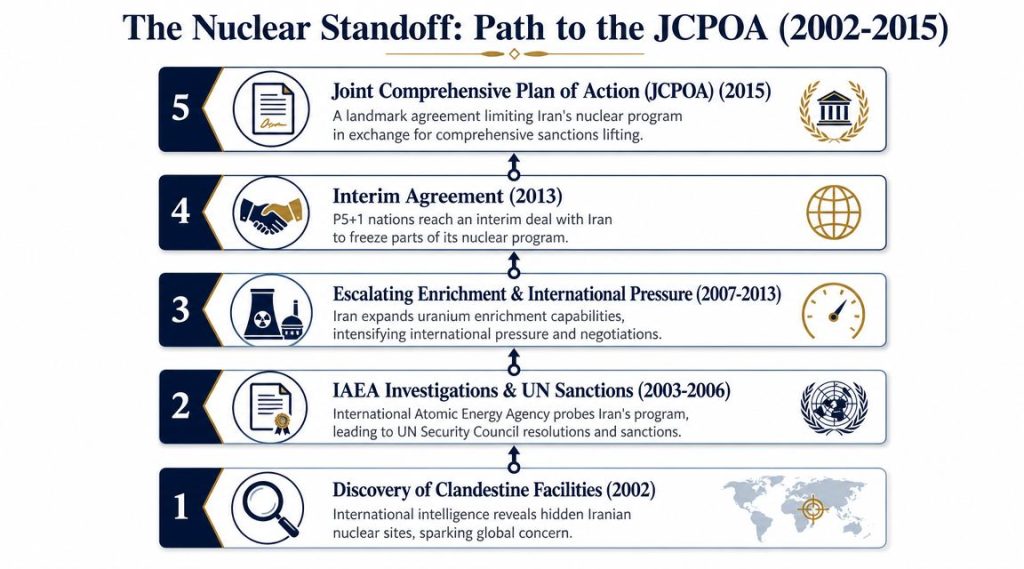
The nuclear issue became the central theater of the Iran US relations timeline because it concentrated every core dispute into one file: sovereignty, deterrence, sanctions, inspections, and regional balance. Once Iran's nuclear program moved to the center of international diplomacy, every other track became subordinate to it.
This visual captures the progression from discovery to negotiated constraint.
Why the standoff became system-defining
The nuclear dispute mattered because it changed the nature of coercion. Earlier sanctions had punished Iran. Nuclear-related sanctions were designed to alter state behavior through a more explicit exchange: restrictions for relief.
That culminated in 2015, when Iran and the P5+1 concluded the plan, a major diplomatic milestone that capped enrichment capacity and stockpiles in exchange for sanctions relief, according to Wikipedia's overview of Iran-United States relations.
The policy logic was clearest in the structure of the deal itself.
- Constraint. Iran accepted limits on its nuclear program.
- Verification. Those limits were meant to be centralized and inspectable.
- Relief. Sanctions relief provided the incentive to comply.
For readers focused on the threat environment around the nuclear file, Iran nuclear threat adds useful current context.
Here's the embedded explainer:
The JCPOA as a coercive diplomacy case
The Council on Foreign Relations presents the clearest analytical frame. Iran accepted limits on its nuclear program in exchange for sanctions relief, but the deal's effectiveness depended on centralized, inspectable constraints. When the Trump administration withdrew in 2018, sanctions were restored and Tehran resumed certain nuclear activities, demonstrating a strong cause-effect linkage, according to CFR's analysis of U.S. relations with Iran.
That point is more than historical. It reveals the core mechanics of successful Iran diplomacy.
Practical implication: On the Iran file, diplomacy works best when pressure, verification, and reversible relief are linked tightly enough that neither side can reinterpret the bargain without visible consequences.
What professionals should take from 2002-2015
The nuclear period offers a simple but often ignored lesson. Iran policy is not just messaging. It is a control system. If inspections weaken, sanctions lose credibility, or enrichment thresholds change materially, the system destabilizes quickly.
A concise decision lens for professionals:
| Variable | Why it matters |
|---|---|
| Enrichment limits | Defines technical breakout risk and diplomatic urgency |
| Inspection confidence | Determines whether compliance is credible |
| Sanctions relief design | Shapes incentives to sustain the agreement |
| Political durability | Determines whether the bargain survives leadership change |
The JCPOA's strategic significance wasn't that it ended hostility. It proved that under enough pressure, with enough technical specificity, the two sides could still produce an operational bargain. Its later collapse would prove the reverse.
JCPOA Collapse and Maximum Pressure 2018-2024
The most consequential fact of this period is straightforward. In 2018, the Trump administration withdrew from the JCPOA and reimposed U.S. sanctions, according to the earlier-cited diplomatic record. The result was not a return to the status quo before the deal. It was a transition to a more unstable environment in which the old guardrails were gone and the pressure escalated faster than replacement diplomacy could form.
What maximum pressure actually changed
The phrase “maximum pressure” can obscure the operational point. The campaign did two things at once. It restored economic coercion and challenged the premise that sanctions relief should be the price of verified nuclear restraint.
Iran's response was not capitulation in a neat bargaining sequence. It was calibrated resistance. Tehran resumed certain nuclear activities after U.S. withdrawal from the deal, as noted earlier through the CFR framework. That didn't just weaken the agreement. It changed the bargaining psychology on both sides.
Washington saw tougher pressure as a means of influence. Tehran saw compliance without durable relief as strategically irrational.
The strategic consequence was loss of predictability
Once the JCPOA framework broke, analysts had fewer reliable indicators for where the escalation ladder ended. Nuclear thresholds became more fluid. Regional incidents took on more significance. Every sanction announcement carried more signaling weight because there was no stable diplomatic container around it.
A practical way to read 2018-2024 is through decision risk rather than headline chronology:
- For policymakers. Coercion regained primacy, but without an effective mechanism to convert pressure into a durable new agreement.
- For markets. Sanctions risk became harder to separate from military risk because the diplomatic buffer had thinned.
- For regional actors. The erosion of constraints encouraged more aggressive hedging, whether through defense posture, covert action, or tighter security coordination.
Why this period led toward direct confrontation
The period after 2018 is often described as a failed negotiation cycle. That's too narrow. It was also a structural transition from controlled nuclear diplomacy back to open-ended confrontation.
The difference matters. Under the JCPOA, escalation had a framework. After withdrawal, escalation had only thresholds and responses. That made each subsequent shock more dangerous, because there was less agreement on what counted as a limit and less confidence that any restraint would be reciprocated.
When a sanctions regime outlives the diplomatic bargain that justified relief, coercion stops functioning as a bargaining tool alone. It becomes the operating environment.
The 2023 prisoner swap and transfer of frozen Iranian funds showed that limited bargaining remained possible even without formal diplomatic relations, according to the earlier-cited diplomatic timeline. But that event should be read carefully. It demonstrated transactional capacity, not strategic reconciliation.
By the end of this phase, the central question was no longer whether diplomacy could be revived in principle. It was whether military events would outrun it in practice.
Direct Conflict and Strategic Shifts 2025-Present
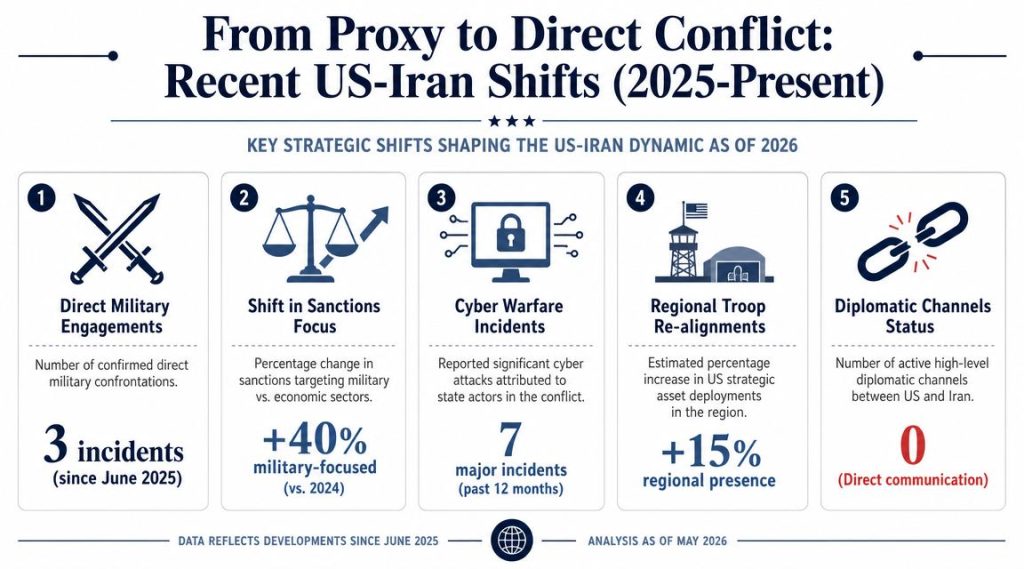
Before June 2025, the working assumption in most risk models was familiar. Washington and Tehran would keep competing through sanctions, proxies, covert action, and maritime pressure, while both tried to avoid a direct U.S. strike on core Iranian nuclear facilities. That assumption failed when the United States hit Fordow, Natanz, and Isfahan after the Israel-Iran war widened, according to Britannica's U.S.-Iran timeline.
A different kind of escalation
The strategic shift was not the use of force alone. It was the target set. Striking nuclear infrastructure moved the conflict into a category with immediate implications for deterrence credibility, sanctions enforcement, and regional military posture.
For analysts, three adjustments follow. Direct state-on-state exchange is now part of the baseline, not a tail risk. Sanctions policy is more likely to tighten in response to military retaliation cycles, which links Treasury action more closely to battlefield developments. Energy and shipping markets must price the possibility that retaliation could move through maritime channels faster than diplomacy can contain it.
This compresses decision time.
Why the Strait of Hormuz sits at the center of the risk picture
The same recent phase also renewed attention on the Strait of Hormuz because any U.S.-Iran military exchange quickly creates fears of disruption along one of the world's most sensitive energy transit routes, as noted in the earlier-cited Britannica timeline. The market consequence is not limited to a closure scenario. Commercial actors react earlier, often at the point where risk becomes plausible rather than certain.
That matters because shipping stress transmits in layers:
- War-risk insurance can reprice quickly when underwriters judge the operating environment to be less predictable.
- Shipowners and charterers can delay sailings or alter routing before any formal interdiction occurs.
- Oil prices can rise on probability and precaution even when physical flows have not yet fallen.
For focused tracking of this maritime pressure point, see analysis of the Strait of Hormuz clash.
The policy and market meaning of the 2025 shift
This phase stands out because diplomatic events and market risks are now harder to separate. In earlier periods, sanctions, nuclear negotiations, and regional security could still be assessed as partially distinct tracks. After the June 2025 strikes, those tracks interact more directly. A military exchange can drive sanctions decisions. A sanctions move can affect shipping compliance and insurance behavior. A maritime incident can then reshape energy pricing and allied force posture.
A practical risk grid makes the shift clearer:
| Risk area | What changed after June 2025 |
|---|---|
| Nuclear diplomacy | Military action now competes directly with any effort to reopen talks |
| Sanctions | Retaliation cycles increase the chance of rapid new restrictions or stricter enforcement |
| Shipping | Hormuz transit decisions became more sensitive to threat perception, inspections, and delays |
| Energy markets | Prices react more sharply to escalation risk, not only to confirmed supply losses |
| Regional security | U.S. partners face greater exposure to spillover, force protection demands, and coordination costs |
Iran's suspension of nuclear talks after the June 2025 escalation matters less as a diplomatic headline than as a structural warning. One of the few channels that could slow escalation has weakened, which leaves military signaling, sanctions pressure, and maritime risk more tightly coupled than at any point in the post-JCPOA period.
Key Themes and the Outlook for US-Iran Relations
The usual assumption is that the Iran file turns on personalities, elections, or the next dramatic incident. Those factors matter, but the historical record points to something more durable. The relationship is governed by recurring strategic patterns.
The three patterns that keep returning
The first is sanctions as statecraft. Since the post-revolution rupture, sanctions have become the central U.S. tool for shaping Iranian behavior. They are no longer temporary pressure instruments. They are part of the architecture of the relationship.
The second is asymmetric response. When facing superior conventional power, Iran has repeatedly relied on indirect means of influence, regional networks, and geographical chokepoints. That doesn't disappear when diplomacy resumes. It gets repriced.
The third is energy and maritime influence. The Strait of Hormuz gives this rivalry an outsized global effect. Even when neither side seeks full-scale war, both know that shipping risk can transmit pressure far beyond the battlefield.
What the outlook suggests
A sober reading of the Iran US relations timeline points to continued instability, punctuated by narrow transactional deals rather than a full strategic reset. The reason is structural. The two sides still lack normal diplomatic relations, still diverge on sanctions and nuclear thresholds, and now operate after a period that has included direct strikes on nuclear sites.
That leaves professionals with a harder but clearer framework:
- Watch sanctions calibration, not just political speeches.
- Track enrichment and inspection dynamics as the fastest indicator of diplomatic movement.
- Treat Hormuz security as an immediate market variable, not a distant contingency.
The broad conclusion is uncomfortable but useful. The relationship is unlikely to return to alliance, and it isn't locked permanently into one uninterrupted path to war. It will probably remain what it has become over decades: a conflict managed through pressure, occasional bargaining, and repeated tests of how much disruption each side is willing to absorb before stepping back.
Vanitiro tracks the U.S.-Iran file the way professionals need it tracked: with clear sourcing, sanctions context, maritime risk analysis, and concise updates that connect diplomacy to markets and security. If you want sharper signal on Gulf flashpoints, nuclear negotiations, and the economic consequences that follow, follow Vanitiro.