 Vanitiro Editorial Team
Roughly one-fifth of Pakistan's economy is absorbed by debt servicing, yet defence remains one of the few major budget lines treated as strategically protected. That matters less as a headline than as a signal of state priorities under fiscal strain.
The central issue is not only the size of the pakistan defence budget. It is the degree to which the published figure understates the full security burden, including pensions, military-run commercial interests, and other costs that sit outside a simple line-item reading. The result is a budget debate that often starts with a large number and stops too early.
Opacity is part of the story. US State Department assessments on fiscal transparency have repeatedly pointed to limits in public visibility over parts of Pakistan's budget process, and defence is the most politically sensitive area within that system. For analysts, this means the official allocation is a starting point, not the full account.
The other question is economic. Every protected rupee in security spending narrows room for health, education, infrastructure, and civilian capacity at a time when Pakistan is managing weak growth, external financing pressure, and recurring reform demands. The budget therefore reflects more than threat perception. It shows how national security choices redistribute scarcity across the state.
Table of Contents
- The Core Numbers Behind Pakistan's 2026 Defence Budget
- Where Does the Money Go? A Breakdown of Spending
- What Drives the Spending? Threat Perceptions and Strategy
- Paying the Bill and the Problem of Opacity
- The Opportunity Cost Defence Versus Social Spending
- Future Capabilities and Key Procurement Projects
- Conclusion Geopolitical Implications and The Path Forward
The Core Numbers Behind Pakistan's 2026 Defence Budget
A government that trims total federal spending while raising defence outlays is making a ranking of priorities. In Pakistan's 2025 to 2026 budget cycle, the defence allocation rose sharply even as the overall federal envelope contracted. The headline matters. The larger point is what sits behind it: security spending retained protection while other claims on the budget did not.
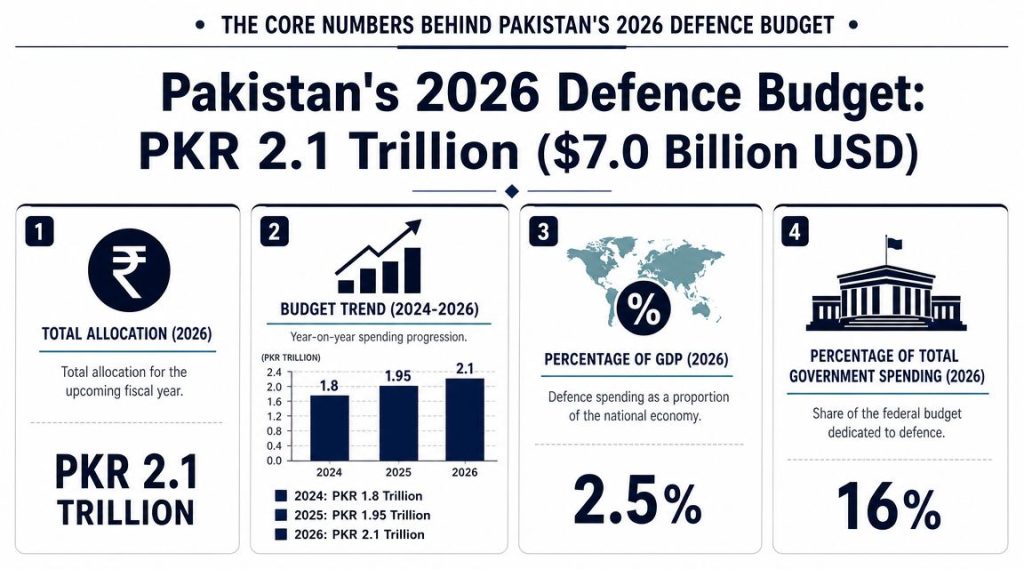
That makes this section the only place to anchor the top-line figures. The budget points to a nominal defence increase of roughly one-fifth, against a smaller total federal budget than the year before. For analysts, the significance is relative allocation, not just the absolute amount. Islamabad chose to preserve military spending power during fiscal stress.
The strategic context also matters. Pakistan's security establishment is budgeting against persistent rivalry with India, border management pressures, and internal militancy. Readers tracking the wider conflict dynamics shaping India-Pakistan security planning should read the budget as part of that broader competitive environment, not as an isolated accounting exercise.
Two cautions are necessary.
First, top-line figures do not capture the full defence burden. Official budget documents often separate military pensions, debt servicing linked to security procurement, and some security-related transfers from the core defence head. That means the public number can understate what the state commits to the security sector.
Second, transparency remains limited. The US State Department has previously raised concerns about uneven fiscal transparency in Pakistan, including the difficulty of tracing some categories of public expenditure. In practical terms, that means the budget is best read as a floor, not a complete map.
For a busy policymaker, three conclusions follow:
- Defence retained priority during fiscal compression.
- The published figure likely understates total security-related spending.
- The economic question is not only how much Pakistan spends on defence, but what other sectors lose fiscal space as a result.
This is the signal in the core numbers. The budget does more than fund the armed forces. It shows that, under conditions of debt pressure and weak growth, the security sector still sits near the top of the state's spending hierarchy.
Where Does the Money Go? A Breakdown of Spending
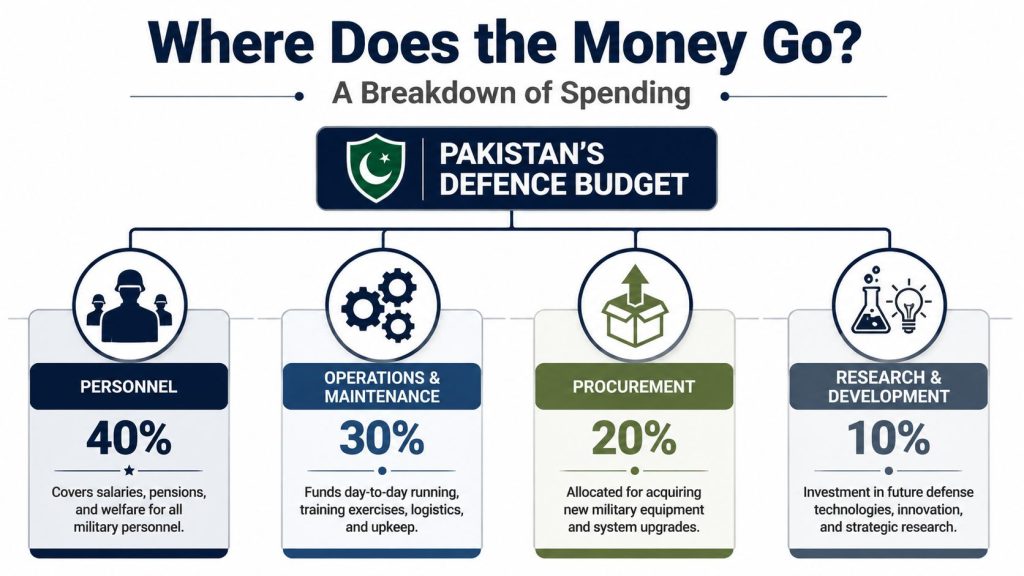
The most useful way to think about the pakistan defence budget is as a household budget with a large mortgage. Once fixed obligations are paid, flexibility shrinks fast. In military budgeting, the equivalent fixed costs are personnel expenses and pensions.
Pakistan's defence spending is around 1.7% of GDP, and the 2024 to 2025 allocation of PKR 2.13 trillion included an 11% year on year increase in salaries and pensions, according to the Pakistan military budget summary. That single detail explains why nominal defence growth doesn't automatically translate into more modern platforms, better training cycles, or stronger sustainment.
Fixed costs shape strategic choice
Personnel spending is often misunderstood as administrative overhead. It isn't. Salaries, pensions, and benefits are part of force structure. Once a state commits to a certain force size and retirement burden, those payments become politically and institutionally difficult to compress.
That creates a simple budgeting logic:
| Spending pressure | Strategic effect |
|---|---|
| Rising salaries | Less room for discretionary capability upgrades |
| Rising pensions | Future budgets inherit old obligations |
| Rigid personnel baseline | Procurement becomes easier to delay than payroll |
| Limited flexibility | Readiness and maintenance can absorb pressure silently |
This is why nominal increases can coexist with capability strain. A bigger budget may still feel tight if a large share is pre-committed.
The real trade-off inside defence
A defence budget isn't one pot with equal strategic value across every rupee. Some categories preserve the institution. Others improve capability. Those goals can compete.
Consider the logic in practical terms:
- Pay and pensions come first: Governments can defer equipment, but they can't easily miss payroll.
- Operations are politically quieter to squeeze: Training tempo, maintenance cycles, and sustainment are less visible than salary decisions.
- Modernization needs surplus fiscal room: New systems usually require not just acquisition, but lifecycle support, spare parts, and training.
- Readiness can erode before headlines notice: A force may look funded on paper while carrying deferred maintenance or slower upgrade cycles.
Rising personnel costs don't just increase spending. They harden the budget and reduce manoeuvre.
For analysts, this is the key internal tension. If compensation costs keep growing, defence modernization requires either a larger total envelope or sharper choices within the force. Without one of those adjustments, headline increases can mask a more constrained reality beneath them.
What Drives the Spending? Threat Perceptions and Strategy
Pakistan's defence choices are driven by a multi-front security view, not a single adversary model. Planners have to think simultaneously about conventional deterrence, border volatility, and internal armed violence. That mix produces a budget logic very different from a state facing only one type of threat.
India remains the central benchmark
The long-running rivalry with India still anchors force planning. It shapes conventional requirements, readiness expectations, and procurement preferences. Air power, air defence, surveillance, and strike capability all matter because planners assume that any serious crisis with India could move quickly and punish weakness early.
That strategic frame also explains why Pakistani decision-makers watch military and political developments across the border closely. For context on that wider environment, Vanitiro's coverage of conflict in India is useful background.
The western frontier pulls resources differently
Pakistan's Afghan border creates a different kind of demand. This isn't primarily about conventional parity. It is about mobility, intelligence, frontier management, and the ability to sustain security operations in difficult terrain.
Internal militant threats add another layer. They don't require the same toolkit as interstate deterrence. They often require persistent deployment, coordination between intelligence and security organs, and long-duration operating costs that don't always produce visible modernization gains.
A government can therefore face three overlapping pressures at once:
- Conventional deterrence needs against India.
- Border security demands along the Afghan frontier.
- Internal security burdens tied to militant violence and instability.
One budget, different wars
These threat sets don't pull spending in the same direction. Conventional deterrence favors higher-end capabilities and modernization. Frontier instability rewards endurance, transport, logistics, and surveillance. Internal security can consume manpower and operating funds for long periods.
A state preparing for one type of conflict can optimize. A state preparing for all three usually pays more and gets less flexibility.
That is the deeper strategic meaning of the pakistan defence budget. It isn't only large because Pakistan wants military prestige. It is under pressure because planners are trying to fund different missions with different time horizons inside a fiscally constrained state.
The result is a budget that does two things at once. It preserves deterrence signaling toward India, while also financing a security posture that must remain active at home and on the western frontier. That dual requirement helps explain why defence stays politically insulated even when the wider economy is under strain.
Paying the Bill and the Problem of Opacity
The official defence figure is important, but it doesn't settle the core analytical question. What does the state spend on security once all relevant channels are counted? That's where opacity becomes the central issue.
The U.S. State Department's Fiscal Transparency Report has urged Pakistan to bring defence and intelligence budgets under full parliamentary scrutiny, indicating that headline figures alone do not reveal how all money is spent or how off-budget items are handled, as summarized in Economic Times reporting on transparency concerns, rendering budget analysis reliable only to the extent of what is disclosed.
Why headline numbers can mislead
A published allocation tells you how much the government says it is appropriating through the visible budget channel. It doesn't automatically tell you whether related security costs sit elsewhere, whether intelligence spending receives equivalent public scrutiny, or how parliament exercises oversight in practice.
That creates three analytical problems:
- Visibility risk: Readers may confuse the published number with the full security burden.
- Oversight risk: Legislators and the public may see totals without seeing granular accountability.
- Policy risk: External lenders and partners may struggle to judge trade-offs if all obligations aren't comparably visible.
The accountability question is strategic
Opacity is often treated as a governance issue. It's also a strategic issue. When oversight is limited, it becomes harder to evaluate whether rising spending is improving readiness, preserving institutional privileges, or broadening the part of the state least exposed to civilian review.
The critical distinction isn't just between high and low spending. It's between visible spending and auditable spending.
For policymakers, that distinction changes how the pakistan defence budget should be read. A larger figure may reflect real security needs. It may also conceal a broader ecosystem of military and intelligence finance that the headline number does not capture cleanly. Without stronger scrutiny, it's difficult to know how efficiently the state is converting fiscal sacrifice into usable security outcomes.
The Opportunity Cost Defence Versus Social Spending
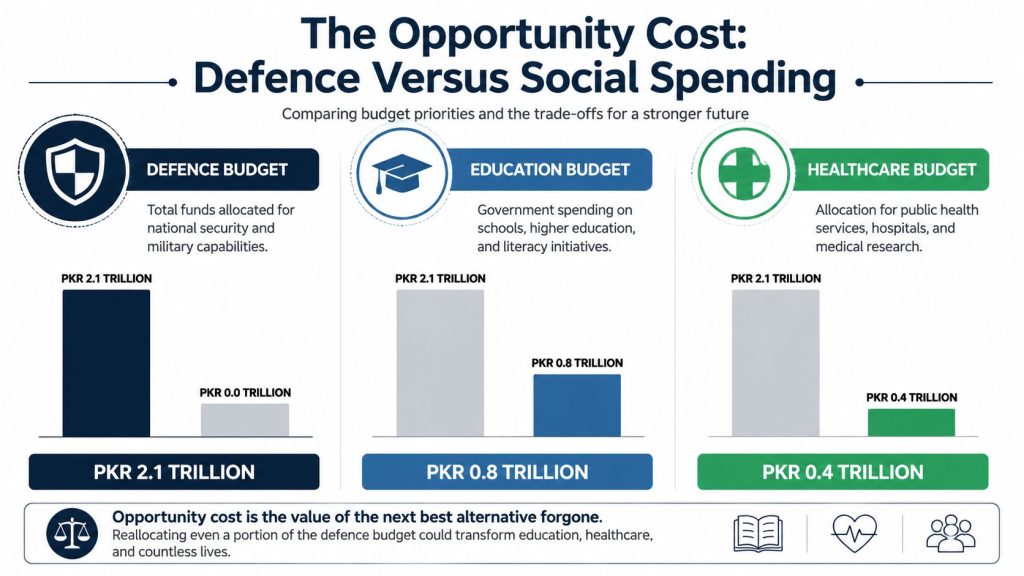
Every defence budget is also a statement about what won't be funded as fully elsewhere. In Pakistan's case, the opportunity cost is especially consequential because the state is making hard budget choices under economic strain.
That's why the key comparison extends beyond military versus non-military in moral terms. It is fixed security commitments versus the state's capacity to invest in long-horizon civilian resilience. Analysts watching fiscal stress and public stability should read those two priorities together, not separately.
What opportunity cost means in practice
When defence is protected, governments usually don't eliminate civilian sectors outright. They constrain them gradually. The result can be slower improvements in schools, hospitals, power systems, and administrative capacity. Those effects are less dramatic than a weapons purchase, but they shape long-term state strength.
A policymaker should think about opportunity cost in four layers:
- Human capital: Education spending affects future productivity, skills, and state legitimacy.
- Public health capacity: Healthcare outlays shape resilience during shocks and everyday service delivery.
- Infrastructure quality: Civilian capital spending supports growth and social cohesion.
- Reform bandwidth: Governments with rigid security spending have less room to absorb reform pain elsewhere.
For readers tracking broader macro-risk, Vanitiro's energy market analysis offers a useful parallel. Fiscal choices in security often spill into commodity exposure, subsidy decisions, and broader political risk.
Security isn't only military
The hardest budget question for Pakistan isn't whether security matters. It clearly does. The harder question is whether the state's definition of security is too narrow.
A country can preserve armed capability while underinvesting in the civilian systems that make societies more governable and less fragile. That is the actual trade-off. Not defence versus welfare as slogans, but immediate coercive capacity versus the slower foundations of national resilience.
Practical rule: If a state protects military spending during austerity, analysts should ask which civilian functions are being asked to absorb the adjustment.
That question matters because social underinvestment can feed the very instability that security institutions are later asked to manage. In that sense, the opportunity cost of the pakistan defence budget isn't just developmental. It can become security-relevant in its own right.
Future Capabilities and Key Procurement Projects
The procurement side of the pakistan defence budget matters because it shows how Islamabad wants to shape its future force, not just sustain its existing one. Even when exact line-item visibility is limited, the direction of travel is still visible in public discussion: air power, air defence, and naval modernization remain central to capability planning.

What modernization appears designed to do
Open discussion around systems such as the JF-17 Block III, Chinese-supplied naval platforms, and air defence upgrades points to a familiar objective set. Pakistan appears focused on preserving credible deterrence, improving survivability, and avoiding technological stagnation relative to regional competitors.
Those priorities line up with the strategic drivers described earlier:
- Air combat relevance supports deterrence against India.
- Air defence investment reduces vulnerability in crisis.
- Naval upgrades widen strategic options beyond the land frontier.
- Platform modernization helps offset fiscal asymmetry by seeking selective capability gains rather than across-the-board parity.
That logic is important. Pakistan doesn't need symmetric spending to pursue asymmetric effect. A financially constrained military often prioritizes systems that complicate an opponent's planning rather than matching every capability category.
Capability is more than acquisition
Procurement headlines can mislead if they're read as self-executing. Buying platforms is only part of force development. Integration, training, maintenance, munitions support, and doctrine matter just as much.
The following video gives useful visual context for how these modernization questions are framed in public discussion:
A smart reading of the pakistan defence budget therefore separates announced capability ambition from sustained operational effect. Pakistan can continue modernizing in selective areas, especially where it sees high deterrent value. But the same budget rigidity discussed earlier means each new capability carries recurring support costs. That makes modernization not just a procurement question, but a long-term affordability test.
Conclusion Geopolitical Implications and The Path Forward
The pakistan defence budget is best understood as a stress test of the state itself. It shows what Islamabad is willing to protect when money is tight, what trade-offs it is prepared to impose elsewhere, and how much of the actual security burden remains difficult to audit from the outside.
Three conclusions follow.
First, defence has a protected status in Pakistan's fiscal order. The recent pattern of rising military spending during wider restraint shows that security institutions retain priority even under budget compression.
Second, the published figure doesn't resolve the accountability question. If defence and intelligence finance remain only partially transparent, analysts should treat the official number as necessary but incomplete.
Third, the long-run strategic risk may be internal as much as external. A state can sustain high security spending for years. What is harder is sustaining it while also preserving legitimacy, service delivery, and economic flexibility.
That broader regional context matters beyond South Asia. Pakistan's choices affect crisis stability with India, shape the value of Chinese defence ties, and influence how Western governments think about oversight, assistance, and political risk. For readers following how conflict, fiscal pressure, and regional alignment interact across theaters, Vanitiro's coverage of the Middle East conflict today offers a useful comparative lens.
The path forward is conceptually clear even if politically difficult. Pakistan would need stronger parliamentary scrutiny, cleaner visibility across defence and intelligence accounts, and a clearer framework for balancing coercive security with civilian resilience. Without those reforms, future increases may continue to signal resolve, but they won't necessarily demonstrate efficiency or long-term stability.
If you want sharp, source-conscious geopolitical analysis without the noise, Vanitiro is worth following. It tracks conflict, diplomacy, sanctions, and the economic aftershocks with the kind of clarity busy policymakers, journalists, and analysts need.