 Vanitiro Editorial Team
The most important thing in russia and iran news is also the most misunderstood. This isn't a durable alliance built on trust. It's a partnership of necessity between two sanctioned states that need each other more than they like each other.
That distinction matters. Since Russia's full-scale invasion of Ukraine, Moscow and Tehran have moved from cautious engagement to much deeper cooperation across politics, military affairs, and economics, including increased arms transfers, dark port calls, and new trade agreements, according to CNA's assessment of the evolving Russia-Iran relationship. But faster cooperation doesn't erase older instincts. Iran still guards its sovereignty jealously. Russia still keeps room to maneuver with other regional players. Each side is trying to convert isolation into advantage.
For ministers, investors, and security planners, the implication is straightforward. Russia-Iran coordination now reaches well beyond bilateral diplomacy. It touches sanctions enforcement, defense-industrial supply chains, energy logistics, maritime risk, and the military balance from Ukraine to the Gulf. The core analytical mistake is to treat every new agreement as proof of a true bloc. The better question is narrower and more useful: how far will this partnership go when interests align, and where does it break when they don't?
Table of Contents
- The New Reality of Russia-Iran Relations
- A Long History of Mistrust and Cooperation
- The 2025 Comprehensive Strategic Partnership Treaty
- The Military and Security Axis in Focus
- Timeline of Recent Russia-Iran Developments
- Global Implications for Energy and Security
- Future Scenarios and Policy Outlook
The New Reality of Russia-Iran Relations
Russia and Iran are no longer operating as parallel challengers to the West. They are working as a partnership of necessity, shaped by shared sanctions pressure, wartime demand, and a common interest in complicating US and European policy. Since 2022, that relationship has shifted from selective cooperation to coordinated activity across defense production, shipping, finance, and diplomacy, according to CNA's analysis of the evolving Russia-Iran relationship.
The strategic point is straightforward. This is not a true alliance. It is a transactional alignment between two states that need each other more than they trust each other.
That distinction matters for policymakers and markets. A formal alliance would imply stable obligations and predictable escalation risks. This relationship creates a different problem. It is flexible, deniable, and harder to disrupt because cooperation can expand in one channel even when friction rises in another. For a wider view of how Tehran balances such partnerships, see this analysis of Iran's diplomatic relations and external balancing strategy.
Why this shift matters now
Three developments give the relationship more weight than its public symbolism suggests.
- Sanctions are driving institutional adaptation: Moscow and Tehran are building workarounds in banking, logistics, and procurement that help both absorb external pressure.
- Military ties now shape multiple theaters: Cooperation linked to Ukraine also affects air defense planning, regional deterrence, and the calculation of outside powers operating in the Middle East.
- Commercial links have become strategic infrastructure: Shipping access, energy coordination, and industrial transfers now help preserve wartime resilience and regime durability.
Practical rule: Military, commercial, and diplomatic developments in the Russia-Iran relationship now form one interconnected system.
The main risk is analytical complacency. Because the partnership lacks the ceremony and treaty language of a classic bloc, it is easy to underrate its effect. That would be a mistake. Russia gains drones, munitions pathways, and sanctions-evasion options. Iran gains military relevance, political cover, and a stronger hand against isolation.
The deeper conclusion is less obvious. Partnerships built on necessity can still be dangerous, especially when both sides believe time is against them. That makes the Russia-Iran connection more volatile than a settled alliance and more consequential for sanctions enforcement, maritime security, defense supply chains, and energy price risk.
A Long History of Mistrust and Cooperation
Russia and Iran are cooperating more closely than at any point in years, yet neither side behaves as if trust is settled. The relationship is built on converging pressures, not shared identity. That distinction matters because it explains why tactical coordination can expand quickly while political confidence remains limited.
Iran's modern foreign policy has been shaped by a long memory of outside interference and by a persistent effort to preserve room for independent action, as outlined in the Atlantic Council's historical analysis of Iranian foreign policy. That history helps explain a pattern often missed in day-to-day coverage. Tehran will work with Moscow where interests overlap, but it resists any arrangement that looks like dependence.

This is why the Russia-Iran relationship is best understood as a partnership of necessity.
For Tehran, Russia is useful because it can provide diplomatic cover, military cooperation, and access to channels that soften the effect of sanctions. For Moscow, Iran offers drones, regional access, and an experienced sanctions-survival partner. But utility is not the same as alignment. A broader review of Iran's diplomatic relations shows that Tehran has long tried to balance external ties rather than bind itself to a single great power.
Historical memory imposes real limits on cooperation. Iranian officials and strategists do not forget Russia's imperial role in Persia, nor do they ignore more recent cases where Moscow treated Iranian interests as secondary to its own bargaining position. That legacy creates a habit of hedging. Tehran cooperates in narrow lanes, protects decision-making freedom, and watches for signs that Russia may trade Iranian interests for advantage elsewhere.
The clearest evidence came when Russia backed the United Arab Emirates in the dispute over the islands claimed by Iran in the Persian Gulf. Iran's response was immediate and sharp. Foreign Minister Hossein Amir-Abdollahian warned that Iran would not allow its independence, sovereignty, and territorial integrity to be harmed by Russia or any other power, as noted in the same analysis.
That episode exposed the central friction point in the relationship. Shared sanctions pressure can push Moscow and Tehran together on defense production, transport links, and diplomatic coordination. It does not erase rivalry over status, regional influence, or territorial sensitivity. On those questions, mistrust returns quickly.
The strategic implication is straightforward. Analysts should not read military cooperation or high-level visits as proof of an alliance in the classic sense. This relationship is durable because both governments need it. It is also unstable because both are transactional, suspicious, and prepared to protect their own priorities first.
For global security and markets, that makes the relationship harder to assess than a formal bloc. It can tighten fast under pressure, especially when both sides need sanctions workarounds or military supply. It can also produce sudden friction when national prestige, regional diplomacy, or sovereignty disputes come into play. That volatility is its defining characteristic.
The 2025 Comprehensive Strategic Partnership Treaty
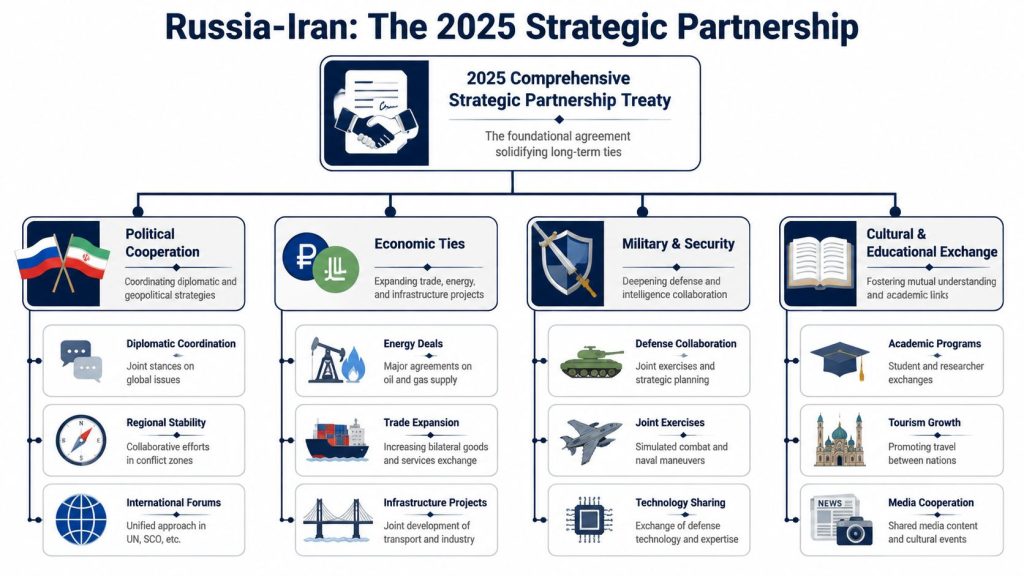
The treaty signed on 17 January 2025 matters because it turns a sanctions-driven relationship into a standing mechanism. When Vladimir Putin and Masoud Pezeshkian approved a 20-year Extensive Strategic Partnership Treaty spanning 47 articles, later ratified and brought into force, they gave ministries, banks, security agencies, and state firms a clearer basis for repeat cooperation, as detailed by the Middle East Council on Global Affairs.
That is the practical significance.
The document covers defense, counter-terrorism, energy, finance, technology, cybersecurity, and regional coordination. The point is not symbolism. The point is to reduce delay, clarify channels, and make joint work easier to sustain when both governments face external pressure. That includes the diplomatic arena around sanctions and inspections, which matters for readers tracking UN debates over Iran.
What the treaty actually changes
The agreement does three things with real strategic effect.
- It creates a longer planning horizon: A 20-year term gives bureaucracies and state-linked companies more confidence that projects will survive political swings and leadership changes.
- It broadens the machinery of cooperation: The relationship is no longer limited to one-off arms deals or leader-level meetings. It now has a written basis across finance, energy, technology, and security.
- It lowers operating friction: Once ratified, officials can move from political intent to implementation more easily, especially in areas such as training, intelligence contacts, nuclear energy cooperation, and payment arrangements.
For sanctioned states, that matters in concrete ways. Fewer legal and procedural obstacles mean faster coordination, more predictable planning, and a better chance of keeping supply chains and financial links running under pressure.
What the treaty does not do
The treaty still stops short of mutual defense commitments. That omission is the clearest evidence that this is a partnership of necessity, not a true alliance.
Moscow and Tehran chose a flexible framework because both want cooperation without surrendering freedom of action. Russia wants room to manage ties with Arab Gulf states, Israel, and Western powers when useful. Iran wants Russian support, but not at the price of dependence on a partner with a long record of bargaining hard and hedging its bets.
That restraint has direct implications for policymakers and markets. The treaty raises the baseline level of coordination between two heavily sanctioned powers. It can improve their ability to move capital, technology, and security cooperation through more durable channels. But it also preserves ambiguity. In a crisis, each side still has scope to limit support, redefine priorities, or trade issues away if national interests require it.
That is the core point. The treaty gives the relationship legal structure and staying power. It does not erase mistrust, and it does not create an indivisible bloc.
The Military and Security Axis in Focus
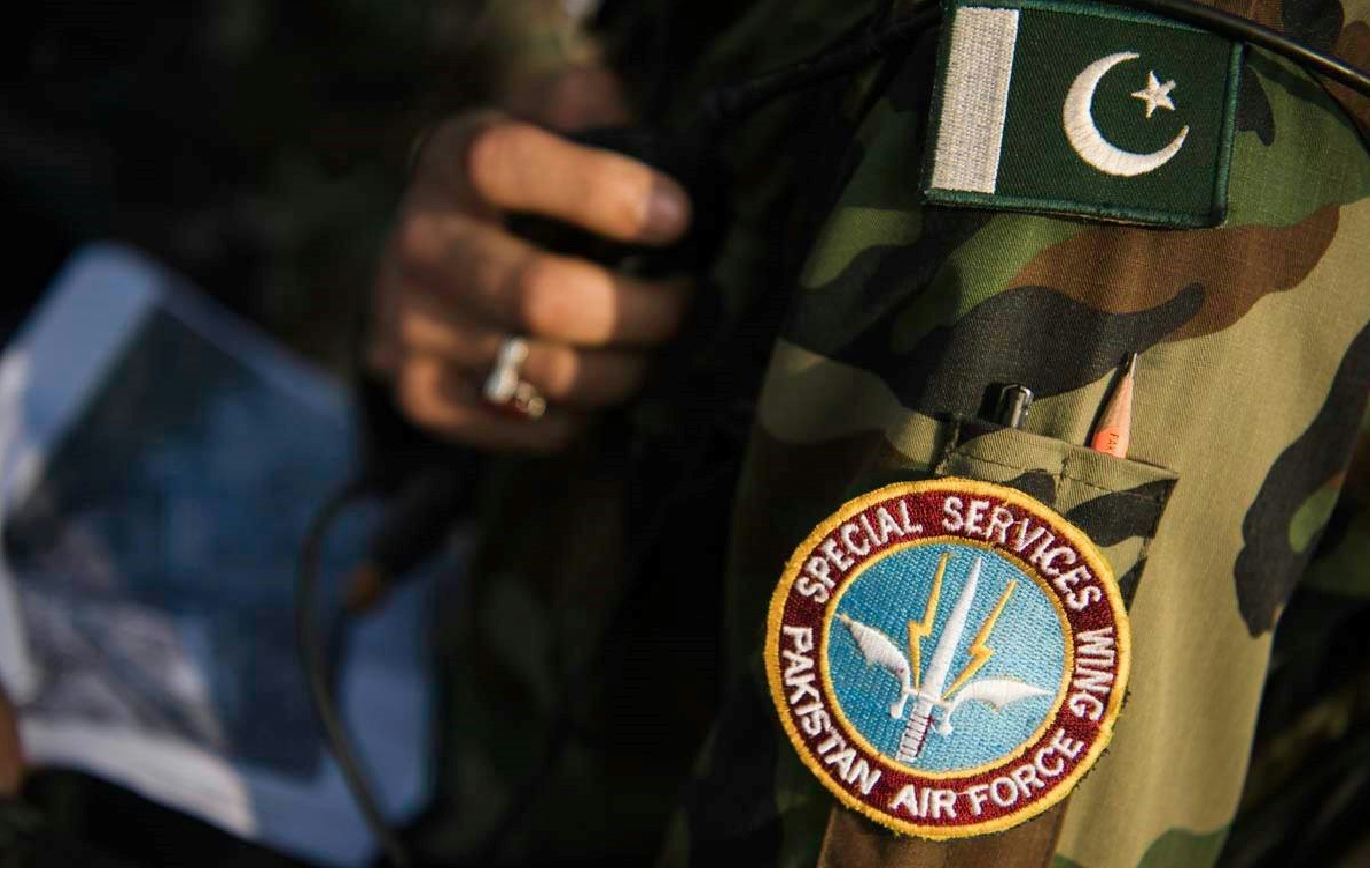
The military relationship is where the shift became undeniable. Iran has supplied Russia with Shahed-136 drones and, according to reporting cited by Stimson, around 400 surface-to-surface ballistic missiles from the Fateh-110 family, including Zolfaghar variants with estimated ranges of 300-700 km, as examined in Stimson's analysis of Russia-Iran military cooperation.
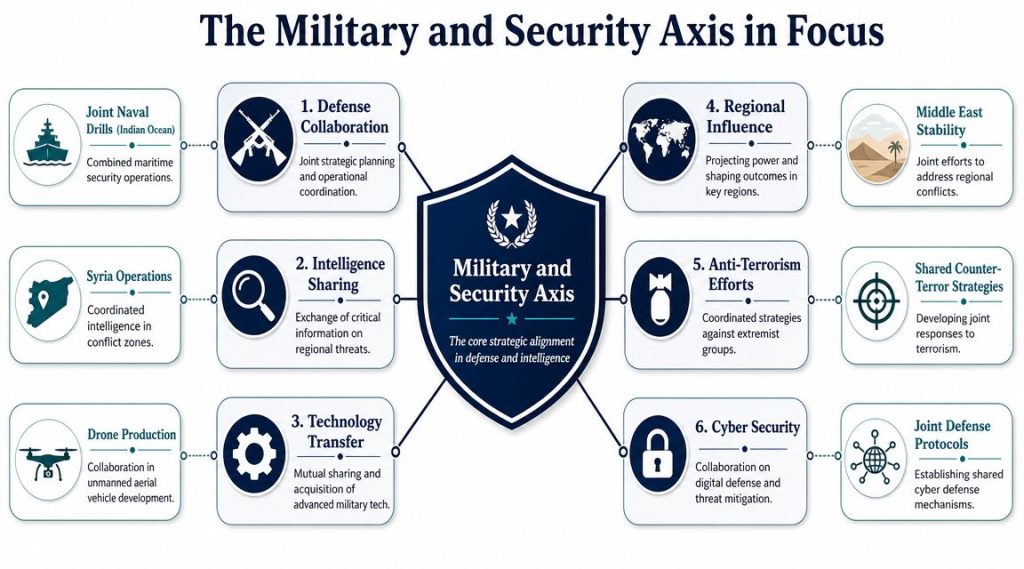
This isn't just an arms transfer story. It's a production, training, and learning relationship that alters how each side fights under sanctions.
How military cooperation became operational
Russia's interest is straightforward. Iranian systems help support cheaper, more scalable saturation attacks. In a prolonged conflict, lower-cost strike options matter. They allow pressure to be sustained even when higher-end munitions are constrained.
Iran's return is different but just as important. It gains battlefield feedback, strategic advantage, and evidence of how its systems perform in a major war. That's valuable for doctrine, procurement, and future export positioning.
Readers tracking multilateral diplomacy can also situate this military channel within a wider contest over legitimacy and enforcement through this overview of the United Nations and Iran, which helps explain why battlefield cooperation and diplomatic shielding often move in parallel.
A visual summary helps frame the core pillars of this security relationship.
Why this is more than arms trading
The Stimson analysis argues that the partnership now looks like a repeatable supply-and-learning loop. That's the right phrase. One side supplies systems and know-how. The other side uses them at scale. Both sides learn. Both adjust.
Three implications follow.
- Defense-industrial resilience grows: Repeated cooperation builds habits, channels, and technical familiarity.
- Interdiction gets harder: Alternative logistics and financing methods become more practiced over time.
- Deterrence calculations change: Regional actors and Western planners have to assess not just current transfers, but a maturing military-technology relationship.
Watch for repetition, not spectacle. A recurring military exchange matters more than a single dramatic shipment.
This is also why simplistic “axis” language can obscure more than it clarifies. The military bond is serious, but it remains conditional. Russia wants supply, scale, and flexibility. Iran wants feedback, influence, and strategic return. Both are extracting value. Neither is handing the other a blank check.
Timeline of Recent Russia-Iran Developments
Key events in Russia-Iran relations 2022 to 2026
The sequence matters because it shows how Russia and Iran built habits of cooperation under pressure, while still stopping well short of a fully trusted alliance. The pattern is practical, not sentimental. Both states widened coordination where sanctions, war, and diplomatic isolation created immediate incentives. Both also preserved room to diverge where core national interests clashed.
| Date | Event | Significance |
|---|---|---|
| 2022 | Russia-Iran ties accelerate sharply after Russia's full-scale invasion of Ukraine | The relationship shifts from cautious cooperation to sustained coordination across military, diplomatic, and economic channels. That change makes the file relevant to Europe, the Gulf, and global commodities markets, not just the Middle East |
| Late 2022 | Iranian drones become a major issue in the Ukraine war | The partnership gains a battlefield dimension with direct strategic consequences. This raises the cost of treating Russia-Iran ties as a regional side story |
| Post-2022 period | Arms transfers, training activity, dark port calls, and bilateral and multilateral exercises increase | Military cooperation becomes more routine. Repetition matters more than any single shipment because it builds logistics familiarity and institutional memory |
| Post-2022 period | New trade arrangements, banking links, and investment discussions expand | Economic ties start serving sanctions survival and payment workarounds, not just diplomatic symbolism |
| 2023 | Progress on the International North-South Transport Corridor receives renewed attention from both governments | The relationship broadens beyond arms and diplomacy into freight, transit, and sanctions-resistant trade routes. That has implications for customs enforcement, insurers, and regional ports |
| July 2023 | Tensions surface after Russia backs the UAE position in the dispute over islands claimed by Iran in the Persian Gulf | Tehran's sharp reaction exposed a basic constraint. Cooperation with Moscow does not override Iranian sensitivity on sovereignty or Russia's willingness to hedge with Gulf partners |
| 17 January 2025 | Putin and Pezeshkian sign the Strategic Partnership Treaty covering defense, energy, finance, technology, cybersecurity, and regional coordination | The agreement formalizes areas where cooperation was already underway. It signals intent, but it does not erase the relationship's transactional character |
| 2025 | Russia's parliament ratifies the treaty and implementation begins | The partnership moves from political messaging into state administration, which matters more for sanctions enforcement and procurement tracking than summit rhetoric alone |
| 2025 | Financial coordination and alternative settlement efforts draw greater scrutiny from sanctions authorities | The economic track becomes more operational. That shifts attention from headline diplomacy to compliance risk, banking exposure, and trade concealment methods |
| 2025 to 2026 | Russia-Iran developments increasingly intersect with energy-market risk, maritime security, and sanctions-evasion scrutiny | The bilateral relationship now affects insurers, shipowners, energy traders, and compliance teams. For a broader view of how geopolitical shocks feed into pricing and trade flows, see this energy market analysis |
Three judgments follow from the timeline.
- Cooperation accelerated under pressure: The sharpest advances came after both states faced heavier military and sanctions stress.
- Practice came before paperwork: Repeated exchanges in logistics, trade, and security created the basis for later formal agreements.
- Friction remained structural: The island dispute, competing regional priorities, and Russia's balancing with Arab states show why this remains a partnership of necessity rather than a true alliance.
The timeline reveals simultaneous movement in two directions. Institutional cooperation is getting thicker. Strategic trust is not.
Global Implications for Energy and Security
Russia-Iran ties matter to global markets not only because of missiles or diplomacy, but because they shape risk pricing in energy and shipping. As noted in the Fox News commentary on the aftermath of the Iran war and ceasefire risks, the partnership has material spillover into energy and maritime security, and Russia can benefit from Iran-related disruption that lifts global risk premiums on oil or shipping insurance.
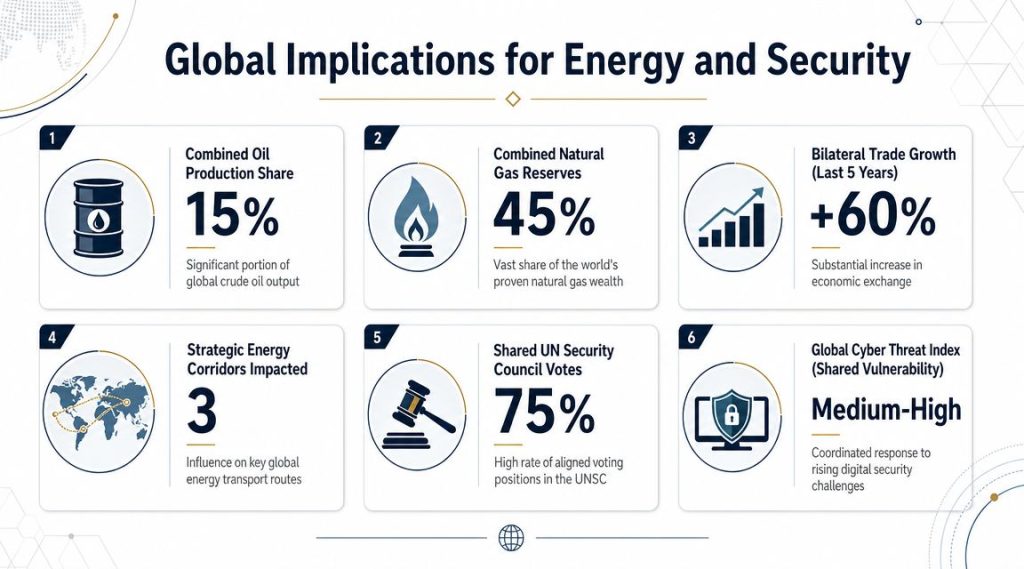
The infographic above is useful as a visual cue, but the strategic point should be made qualitatively and carefully. The most important effect is not a single price move. It's the way repeated instability changes compliance costs, route selection, insurance assumptions, and sanctions enforcement.
Why oil and shipping markets care
When Iran-related tensions threaten maritime flows or raise the risk of interdiction, the market reaction isn't confined to Iranian cargoes. Traders, insurers, and shipping operators widen their risk lens. Russia can gain indirectly if higher geopolitical risk supports stronger oil pricing or tighter shipping conditions for competitors.
For analysts following the commercial side of that story, broader context on energy market analysis helps connect geopolitical shocks to freight, insurance, and pricing decisions.
This is why cabinet briefings should treat Gulf security and Russia sanctions policy as linked files. A disruption involving Iran can alter sentiment around maritime insurance, naval escort risk, and sanctions compliance. That in turn affects Russian opportunities and Russian vulnerabilities.
Why sanctions enforcement gets harder
The same dynamic complicates enforcement. The more instability surrounds Iran-related trade and shipping, the harder it becomes to separate commercial risk from sanctions-evasion risk. Scrutiny intensifies across shadow fleets, opaque ownership structures, and alternative payment channels.
Two points deserve emphasis.
- Russia can benefit from disruption: If Iran-related instability lifts global risk premiums, Moscow may gain revenue or bargaining space without being the direct combatant.
- Russia also faces exposure: The same scrutiny can tighten around evasion networks and logistics channels connected to sanctioned trade.
Energy logistics and sanctions compliance now sit at the center of the Russia-Iran story.
That's the policy takeaway many headlines miss. This relationship doesn't just challenge military planners. It pressures treasury departments, customs agencies, insurers, and maritime regulators. A single incident at sea, or even the credible threat of one, can ripple through oil pricing, vessel screening, and enforcement priorities.
In other words, russia and iran news has to be read through a market lens as well as a security lens. The partnership changes not just who aligns with whom, but how risk itself is priced.
Future Scenarios and Policy Outlook
The easiest mistake is to treat Russia and Iran as a settled anti-Western bloc. The better reading comes from the Atlantic Council's argument that the relationship is driven more by tactical alignment than by a stable strategic alliance, with Russia often described as an “unreliable ally” in relevant discussions, as discussed in this Atlantic Council expert reaction.
That framing changes the forecast. The right question isn't whether Moscow and Tehran cooperate. They do. The right question is where obligation ends.
Scenario one deeper coordination without a true alliance
This is the most plausible near-term path. The treaty framework supports more coordination in defense, finance, technology, and regional diplomacy. Shared sanctions pressure still gives both states strong incentives to work together.
But even under this scenario, the relationship would remain selective. Cooperation would grow where utility is high and political risk is manageable. It would still stop short of unlimited commitments.
Scenario two transactional stagnation
This outcome is also plausible. Both sides continue to trade, coordinate, and exchange support, but without a major step change. Friction builds gradually over regional priorities, competing relationships, and differing expectations.
Under this model, headlines keep describing an axis, while the substance looks more like periodic bargaining. Each government keeps the other close, but not close enough to become dependent.
Scenario three a visible rupture
A breakdown is less likely than continued cooperation, but it's far from impossible. The pressure points are already visible. Territorial disputes, status competition, differing regional calculations, and Russia's broader balancing behavior could all trigger a public split.
If that happens, it probably won't start with the collapse of every area of cooperation at once. It would begin with a dispute over what one side expected and the other refused to deliver.
The key test is simple. When one side incurs real political or military cost, does the other side step in or step back?
That is the analytical framework ministers should use going forward. Not alliance labels. Not ceremonial language. Watch behavior under stress. Watch whether promises become costly obligations. Watch whether each side still preserves fallback options with other powers.
The most likely conclusion is uncomfortable but useful. Russia and Iran will probably keep moving together where shared pressure pushes them together. They will also keep reminding each other, and everyone else, that necessity is not the same thing as trust.
If you want faster, sharper context on sanctions, conflict spillovers, diplomacy, and the economic effects behind headline risk, follow Vanitiro. It's a strong daily read for policymakers, analysts, journalists, and market professionals who need concise geopolitical coverage with sourcing and strategic context.