 Vanitiro Editorial Team
You're probably doing what most policy professionals, editors, and market watchers do before breakfast. Scanning a flood of alerts about sanctions, summit language, naval movements, aid cuts, treaty deadlines, and energy prices, then trying to decide which items matter and which are noise.
That's the core challenge with foreign policy current events. The problem isn't access to information. It's interpretation. A diplomatic phrase can signal escalation. A sanctions notice can matter less than the banking channels behind it. A naval deployment can be more about signaling to insurers and traders than preparing for combat.
The useful question isn't “What happened?” It's “What mechanism changed, and what follows from that?” Once you read foreign policy that way, headlines become easier to sort. You stop treating diplomacy, markets, and security as separate beats. They're part of the same operating system.
Table of Contents
- Cutting Through the Noise of Global Events
- What Is Foreign Policy in Practice
- The Three Levers of Global Power
- How to Identify Global Flashpoints
- Your Actionable Geopolitical Watchlist
- Why Global Events Impact Your Bottom Line
Cutting Through the Noise of Global Events
Most geopolitical coverage treats crises as isolated episodes. One day it's a sanctions package. The next day it's a military exercise. Then a summit, a tanker incident, or a U.N. dispute. Read that way, the world looks random.
It isn't random. It's layered. States use recurring tools, and those tools produce recurring effects. What changes is the mix, the pace, and the theater. If you can identify the tool being used, you can usually identify the next-order consequence.
That's the durable way to read foreign policy current events. Don't start with ideology or rhetoric. Start with mechanisms.
The signal is usually hidden in implementation
A government statement matters less than many readers assume. The market and security impact often sits elsewhere, in inspection rights, shipping access, financial messaging, customs coordination, targeting rules, or force posture.
Practical rule: When a headline announces a foreign policy move, ask what changed in access, enforcement, or transparency.
That lens helps in fast-moving environments. It keeps you from overreacting to symbolic moves and underreacting to technical ones. A treaty expiration can matter more than a fiery speech. A shipping insurer's pricing can tell you more than a televised press conference.
A second benefit is comparative judgment. Once you focus on mechanisms, very different regions become easier to assess side by side. Rivalry between major powers, sanctions enforcement debates, and maritime tensions don't look identical. But they can still be evaluated through the same framework: what lever is being pulled, what transmission channel is affected, and who bears the cost first.
Why this matters for decision-makers
Busy officials don't need more headline summaries. They need an interpretive model that compresses complexity without flattening it. The right model links diplomatic language to institutional consequences, security moves to industrial capacity, and regional tensions to consumer prices.
That's how you turn scattered developments into usable judgment. And in a cycle where security, economics, and technology increasingly reinforce one another, that kind of reading discipline isn't optional.
What Is Foreign Policy in Practice
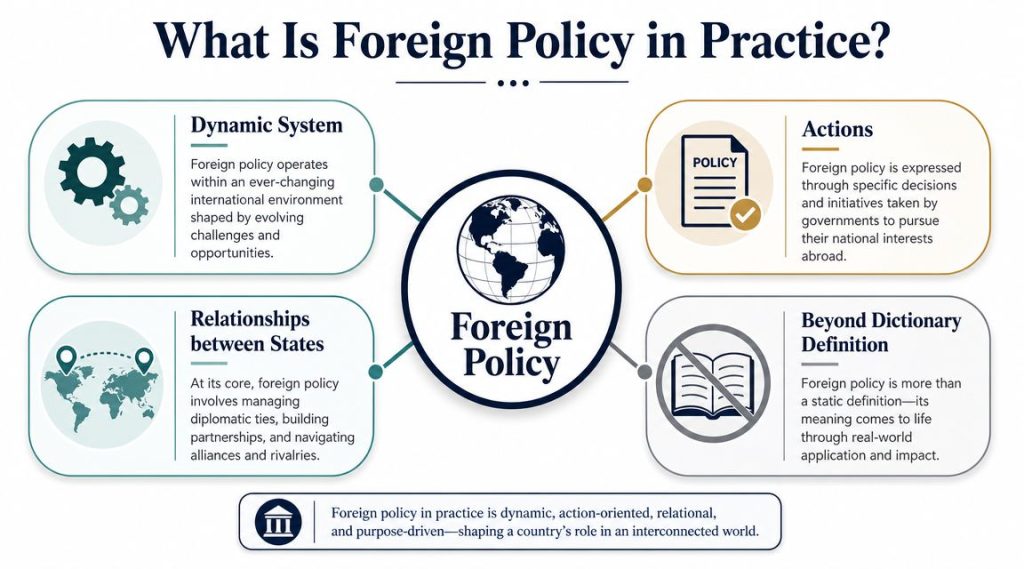
Foreign policy isn't a speech, a doctrine, or a press release. It's the operating logic a state uses to deal with other states, alliances, institutions, and adversaries. Think of it as a high-stakes chessboard, except the pieces can rewrite some of the rules while the game is underway.
The board is larger than diplomacy
In practice, foreign policy includes several moving parts:
- Budgets and allocations: Aid, defense, and procurement choices reveal priorities faster than speeches do.
- Rules and restrictions: Sanctions, export controls, trade preferences, and legal authorities shape what states and firms can do.
- Security arrangements: Alliances, basing access, intelligence sharing, and arms-control agreements create structure, predictability, or pressure.
- Signaling: Public statements still matter, but mainly when they alter expectations about enforcement, deterrence, or negotiation.
That's why a reader who only follows summits misses the complete picture. Foreign policy current events are often decided in the machinery behind the headline.
For a concrete regional example, current debates around Iran are easier to understand when viewed through institutions and legal frameworks, not just confrontation rhetoric. This United Nations and Iran explainer is useful because it places diplomatic pressure inside the broader system that states use to coordinate and contest power.
A treaty deadline can change the whole game
One of the clearest examples is the approaching end of New START. The Council on Foreign Relations notes that in 2026, the last remaining U.S.-Russia arms control treaty is set to expire in February, and once it ends, Washington and Moscow would face a future with no formal caps, no inspection regime, and no treaty-based transparency requirements according to CFR's 2026 foreign policy trends analysis.
That matters for a simple reason. Foreign policy isn't just about asserting power. It's also about managing uncertainty. Treaties don't eliminate rivalry, but they can reduce miscalculation by setting limits, inspections, and reporting expectations. Remove that architecture, and leaders, militaries, and analysts have less verified information to work with.
A diplomatic calendar item can become a security event if it removes transparency rather than merely ending a meeting.
That's the practical definition of foreign policy in action. It's a system of choices that affects what other states know, fear, insure against, and prepare for. If you want to read global affairs well, start there.
The Three Levers of Global Power
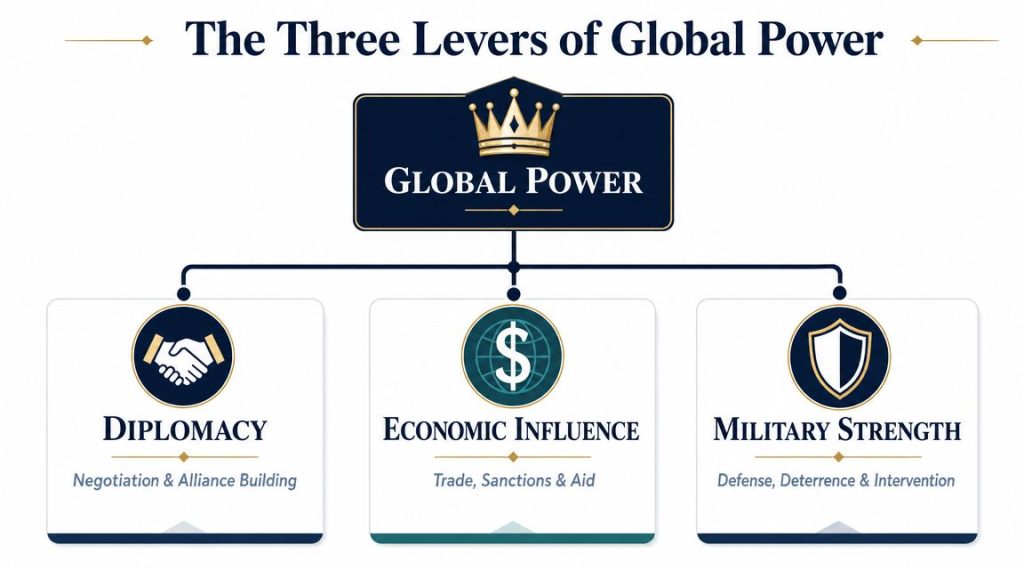
States usually reach for three levers when they want to shape another actor's behavior. They negotiate. They impose costs. Or they threaten, position, or use force. In reality, they often do all three at once.
Diplomacy sets the frame
Diplomacy is more than dialogue. It decides who is inside the negotiating room, what sequence is legitimate, and which off-ramps remain available. A summit, mediator visit, or U.N. vote can reframe a dispute even if it doesn't solve it.
The key analytic point is that diplomacy shapes expectations. It tells markets whether escalation is being managed, tells allies whether coordination is holding, and tells adversaries how much room they still have before coercive tools intensify.
Diplomacy also creates ambiguity on purpose. States sometimes want tension without rupture. That's especially visible in crises where each side wants a bargaining advantage but also wants to avoid uncontrolled escalation.
Economic pressure works through plumbing
Sanctions are often discussed as if they're self-executing. They aren't. Their effect depends less on legal text alone than on enforcement mechanics.
The Council on Foreign Relations notes that the effect of U.N.-linked sanctions depends on three technical variables: the breadth of the targeted financial messaging network, the ability to monitor re-exports and front companies, and whether major trading states coordinate on controls, as explained in this CFR briefing on sanctions mechanics and enforcement. When those controls are weak, trade can shift to third countries and pressure on the target falls.
That's the point many readers miss. Sanctions are not only about punishment. They are about access. Which banks still process payments. Which ports still receive cargo. Which customs systems catch relabeling. Which insurers decide the compliance risk is too high.
A useful way to read sanctions news is to separate announcement from bite:
| Question | Why it matters |
|---|---|
| Which financial channels are targeted? | This determines whether payment friction is broad or narrow. |
| Can authorities track re-exports and front companies? | Weak monitoring creates leakage. |
| Are major trading states aligned? | Without coordination, enforcement gaps widen. |
In the U.S.-Iran context, that means you shouldn't treat sanctions, diplomacy, and maritime pressure as separate stories. They are usually parts of one strategy. Talks can test limits. Sanctions can tighten the economic perimeter. Naval signaling can raise the cost of defiance without crossing into direct conflict.
Military force often speaks to markets too
Military tools include deterrence, deployment, exercises, interception, and in some cases direct strikes. But even when there is no combat, force posture changes behavior.
A carrier movement, air defense alert, or maritime escort presence can influence insurer assumptions, ship routing, and hedging behavior. That's why military signaling frequently has an economic audience as well as a military one.
The most important question in a standoff isn't always whether fighting starts. It's whether participants, shippers, and financiers start acting as if it might.
For analysts, the best reading method is integrated. Ask how the three levers are interacting. If diplomacy narrows, sanctions harden, and naval signaling increases at the same time, the strategy is becoming more coercive even without formal war. If talks reopen while enforcement remains uneven and force posture steadies, policymakers may be trying to preserve pressure while reopening bargaining space.
That's how foreign policy current events move in practice. Not as isolated tools, but as combinations.
How to Identify Global Flashpoints
A market opens to higher oil prices, longer shipping routes, and sudden demand for hedges before any government declares a war. That sequence is common. The policy signal usually appears first. The economic effect follows fast.

Start with the mechanism of risk
A flashpoint matters less because it is dramatic than because it transmits pressure into security commitments, trade flows, capital costs, or supply chains. The first task is classification. Ask what the contest is really about: access to technology, control of territory, coercive signaling at sea, alliance credibility, or domestic regime survival. That choice determines which indicators deserve attention and which headlines are noise.
One broad marker of a harder strategic environment comes from military spending. A 2026 strategic outlook citing SIPRI data says global military expenditure reached about $2.7 trillion in 2024, the highest level since the Cold War's end, at roughly 2.5% of global GDP. The same assessment links the increase to intensified rivalry and to investment in AI, unmanned systems, cyber defense, and quantum capabilities. For analysts, the implication is straightforward. Competition now runs through industrial capacity, software, infrastructure resilience, and production depth as much as through troop numbers.
That changes how flashpoints should be read.
Match the trigger to the system it can disrupt
U.S.-China competition usually shows up through technology controls, industrial policy, export restrictions, maritime signaling, and alliance alignment in Asia. The key question is whether one side is reducing the other's access to capabilities, markets, or chokepoints that matter over a multi-year horizon.
Russia-Europe tension works differently. The central variables are territorial security, force posture, NATO cohesion, and energy exposure. Warning signs there are more likely to come from mobilization patterns, defense production, transit vulnerabilities, and political strain inside the alliance.
Middle East maritime crises move on a shorter clock. They can hit freight rates, insurance assumptions, delivery times, and inflation expectations within days because they sit on critical trade routes. Recent Houthi attacks in the Red Sea are a good example of how a regional security problem can become a shipping and pricing problem well before it becomes a formal interstate war.
A short comparison helps:
| Flashpoint | Primary mechanism | What to watch first |
|---|---|---|
| U.S.-China | Technology, trade, industrial rivalry | Export controls, industrial subsidies, naval signaling, alliance tech coordination |
| Russia-Europe | Military posture, deterrence, energy exposure | Force movements, defense production, NATO cohesion, infrastructure risk |
| Middle East maritime crises | Chokepoints, sanctions, naval pressure | Shipping rerouting, insurance costs, convoy patterns, energy price sensitivity |
The practical test is simple. Identify what each side is trying to deny, defend, or control. Then ask how that objective reaches markets or military balances. If the answer runs through semiconductors, ports, pipelines, shipping lanes, or treaty commitments, the flashpoint deserves close attention even if the headline sounds limited.
The video below is useful background for readers tracking how these broader rivalries fit into current strategic analysis.
Analytic test: Before reacting to a flashpoint, identify what each side is trying to deny, defend, or control. That usually reveals the real arena of competition.
Your Actionable Geopolitical Watchlist
A minister cancels a visit. A shipping insurer raises premiums. A navy changes escort patterns. By the time those signals merge into a major headline, markets have usually repriced part of the risk.
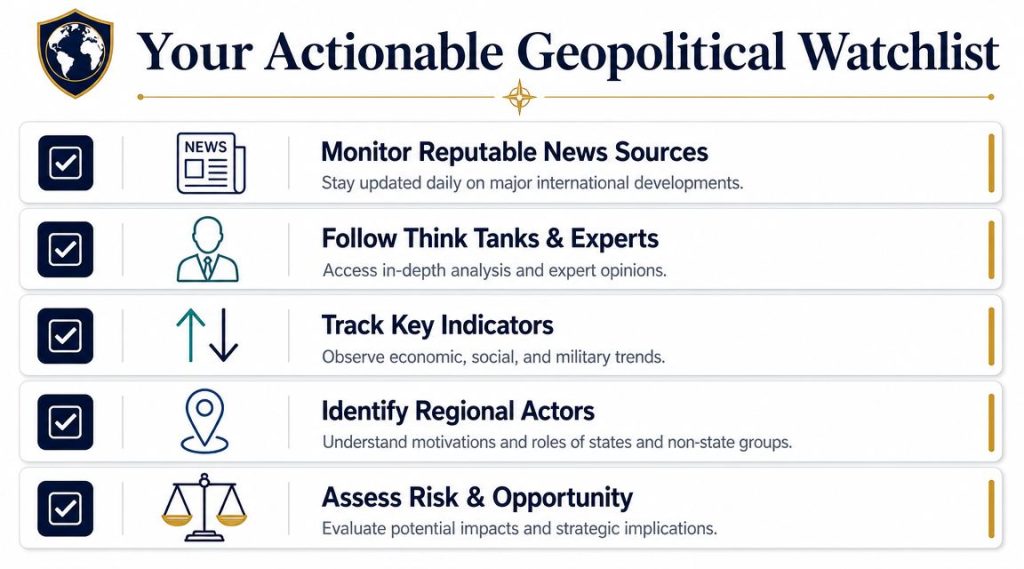
The practical task is to track early indicators in the order they tend to appear. Foreign policy is easier to interpret when you sort events by function. Who is signaling. Who is restricting access. Who is changing facts on the ground. That framework helps readers distinguish theater from moves that can affect supply chains, asset prices, or deterrence.
Watch signals by category
A useful watchlist separates diplomatic, economic, and military indicators because each reveals a different stage of pressure.
Diplomatic signals
Track official statements, ambassadorial recalls, U.N. maneuvering, negotiating formats, and third-party mediation. Public rhetoric matters less than whether channels remain open. If credible intermediaries are still active, governments may be containing escalation even while sounding confrontational.Economic signals
Track sanctions designations, export-control updates, banking restrictions, shipping insurance changes, and signs of trade rerouting. The detail matters. A narrow enforcement action against payment networks or shipping services can have more market impact than a broad political threat that lacks implementation.Military signals
Track deployments, naval escort patterns, air-defense activity, interception reports, readiness shifts, and logistics posture. The important question is not only whether forces move, but whether commercial actors or allies change behavior in response.
Build a short daily routine
For market-sensitive crises, chokepoints deserve constant attention. The Strait of Hormuz is one example. So are the Bab el-Mandeb and other maritime corridors where a local security incident can become an energy or freight problem within days. If you want a market lens for that process, this energy market risk analysis is a useful companion.
A disciplined daily routine can stay simple:
- Check vessel traffic: Use AIS-based shipping data to see whether tankers or container ships are slowing, rerouting, or clustering near high-risk corridors.
- Read freight and insurance signals: Premium changes often show that private firms assign a higher probability to disruption before governments formally acknowledge it.
- Monitor sanctions and licensing updates: Treasury actions, export-control notices, and compliance guidance often reveal the pressure campaign.
- Compare official messaging with commercial behavior: If governments project calm while carriers reduce exposure, the market may be pricing risk more accurately than the headlines.
- Track regional reporting and alliance responses: Local incidents matter more when they trigger convoy operations, emergency diplomacy, or visible reassurance measures.
This is the core habit: watch what states say, what firms price, and what militaries protect. When all three start moving in the same direction, the issue is no longer a passing diplomatic dispute. It is becoming an operational risk.
Watch what insurers, shippers, banks, and logistics managers do. Their decisions often show whether a geopolitical threat is turning into a real economic constraint.
You do not need a large dashboard. You need a repeatable filter that catches early changes in access, enforcement, and force posture. That is how foreign policy current events become readable before they become expensive.
Why Global Events Impact Your Bottom Line
A tanker diverts from a high-risk corridor, insurers raise premiums, and refiners start paying more for supply. Households do not see the diplomatic exchange that set that chain in motion. They see higher fuel bills, tighter margins, delayed deliveries, and renewed inflation pressure.
That is the point of tracking foreign policy current events. The question is not only whether a dispute matters in diplomatic terms. The question is which transmission channel is active, how fast it can spread, and who absorbs the cost first.
Energy is usually the clearest example. A military warning, sanctions move, or maritime incident can change routing decisions within days. Traders then reprice crude, shipping, and insurance risk. Companies pass through part of the increase. Finance ministries and central banks are left judging whether they face a short shock or a broader price problem. Readers who want a practical model for tracing that chain should review this energy market analysis of geopolitical price transmission.
The same logic applies beyond oil. Sanctions can tighten payment routes and raise compliance costs before trade volumes visibly fall. Export controls can disrupt inventory planning long before a factory reports shortages. Military deployments can change commercial behavior even without open conflict, because shippers, banks, and multinational firms price probability, not official reassurance.
For policymakers and investors, the useful habit is to translate headlines into mechanisms. Ask three questions. Does this event restrict physical access, alter legal permissions, or change the use of force? Once one of those variables shifts, domestic consequences usually follow through prices, supply chains, financing conditions, or political pressure.
Foreign policy is not distant from the economy. It is one of the inputs shaping it.
Vanitiro tracks those links, from sanctions enforcement and U.N. maneuvering to Hormuz risk and the market effects of Middle East escalation. If you want concise, source-driven geopolitical coverage built for busy professionals, follow Vanitiro.