 Vanitiro Editorial Team
India lost approximately 71,000 lives to terrorism and extremism over the last decade in major irregular and sub-conventional conflicts, according to the South Asia Terrorism Portal's India conflict backgrounder. That figure reframes conflict in India. It isn't a peripheral security problem at the edge of an otherwise linear rise. It's a central condition shaping how the Indian state governs, allocates force, attracts investment, and projects power.
The analytical mistake is to treat India's border crises, insurgencies, and communal violence as separate files. They aren't. Pressure on the Line of Control affects domestic political incentives. Internal violence changes force posture and legitimacy. Communal polarization can narrow diplomatic flexibility abroad while hardening security choices at home. If India wants to convert economic scale into durable strategic influence, it has to manage not one conflict system, but several overlapping ones at the same time.
Table of Contents
- Understanding the Scale of Conflict in India
- A Framework for Analyzing Indian Conflicts
- The Enduring Border Disputes with Pakistan and China
- Mapping Internal Insurgencies and Communal Flashpoints
- Key Actors and Their Strategic Drivers
- The Domestic and International Implications
- Policy Outlook and Future Conflict Trajectories
Understanding the Scale of Conflict in India
Conflict in India spans multiple theaters at once. Border pressure from two nuclear-armed rivals, persistent insurgent violence in select regions, and recurrent communal unrest all draw on the same pool of state attention, security resources, and political capital.
That overlap matters more than any single headline crisis. A border standoff can shift forces and political focus away from internal stabilization. Internal unrest can harden public opinion and narrow diplomatic room during an external confrontation. Communal violence can damage investor perceptions of order and predictability, even when it remains geographically limited. For a country seeking faster manufacturing growth, supply-chain relocation, and greater strategic influence, conflict is not only a security problem. It is a constraint on national power.
As noted earlier, the cumulative human cost of terrorism and extremism in India has been high over many years. The policy implication is straightforward. New Delhi has had to sustain a long-duration internal security effort while preserving deterrence against Pakistan and China.
Three features define the scale of the problem.
- Conflict is concentrated, not uniform: violence tends to cluster in border zones, historically insurgency-prone districts, and politically sensitive urban settings.
- Conflict has different drivers: territorial rivalry, separatist demands, ideological insurgency, and communal mobilization arise from different incentives and require different state responses.
- Conflict produces system effects: simultaneous pressure across domains raises fiscal demands, strains civil-military coordination, and complicates India's effort to present itself as a low-risk destination for capital.
India's conflict burden is cumulative. The strategic effect comes from concurrency, not only intensity.
This is why analysts assessing geopolitical risk and state stability should treat India's conflicts as an interconnected system rather than a set of isolated episodes. Kashmir sits at the clearest intersection of external rivalry and internal militancy, but the pattern is broader. The same government that must manage frontier deterrence also has to maintain domestic legitimacy, contain localized violence before it spreads, and protect the economic conditions required for sustained growth. India's rise therefore depends not only on winning crises, but on preventing one conflict theater from amplifying another.
A Framework for Analyzing Indian Conflicts
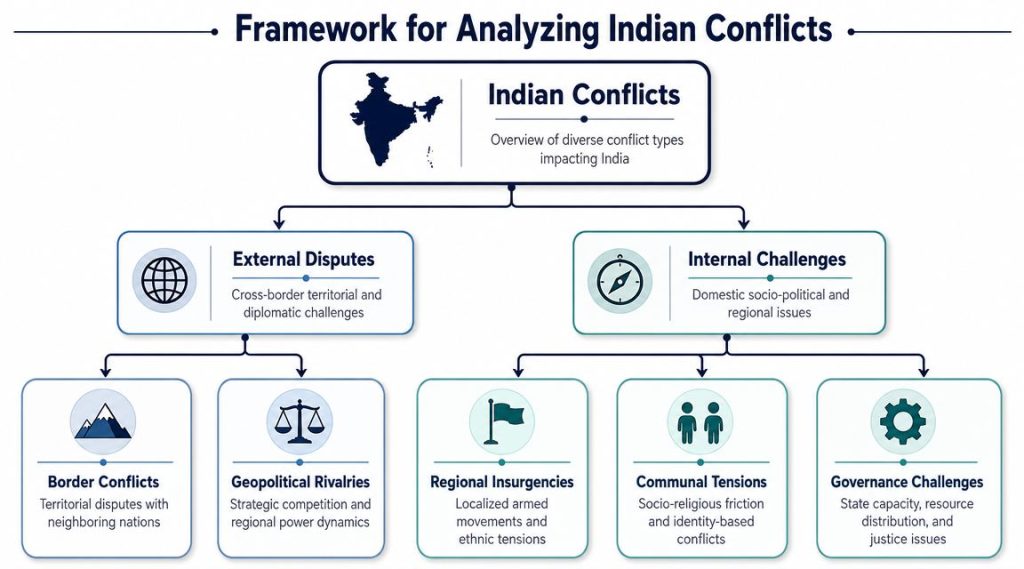
A useful framework separates conflict in India into external disputes and internal challenges, then asks how those layers interact. That approach prevents a common analytical failure. Border crises get treated as strategic, while internal violence gets treated as local. In practice, both affect state capacity, legitimacy, and risk pricing.
A usable taxonomy
Four core categories matter most: interstate border disputes, internal separatist and autonomy insurgencies, ideological insurgency, and communal or sectarian violence.
Interstate disputes are primarily about territory, deterrence, and escalation control. Internal separatist conflicts are about sovereignty, autonomy, and competing national identities. Left Wing Extremism is rooted in ideological revolt and state reach. Communal violence sits in a different category again, because it often emerges from social polarization and political mobilization rather than sustained territorial insurgency.
That distinction helps policymakers choose the right instrument. Military signaling may matter at a frontier. It won't resolve communal distrust. Police-heavy responses may contain riots. They won't settle a long-running sovereignty dispute.
Readers tracking broader geopolitical risk coverage at Vanitiro will recognize the pattern. States rarely face isolated security problems. They face interacting theaters that reinforce each other through politics, media narratives, and institutional strain.
Major conflict categories in India
| Conflict Type | Primary Region(s) | Core Issue | Key Actors |
|---|---|---|---|
| Interstate border disputes | Jammu and Kashmir, northern frontier with China | Territorial control, deterrence, border management | Indian state, Pakistan, China |
| Internal separatist and autonomy insurgencies | Jammu and Kashmir, Northeast | Sovereignty, autonomy, ethnic identity | Indian state, regional insurgent groups, militant networks |
| Ideological insurgency | Left Wing Extremist-affected areas | State legitimacy, governance, revolutionary politics | Indian state, Maoist cadres |
| Communal and sectarian violence | Urban and rural flashpoints across multiple states | Identity conflict, political mobilization, local grievance | Communities, political actors, local security forces |
This framework yields a less obvious conclusion. India's security problem isn't only that it has many conflicts. It's that each type pushes the state toward a different model of authority. Border disputes reward centralization and hard deterrence. Insurgencies require persistence and political accommodation. Communal tensions demand legitimacy, restraint, and credible impartiality. Balancing those models is one of the hardest tasks in Indian statecraft.
The Enduring Border Disputes with Pakistan and China
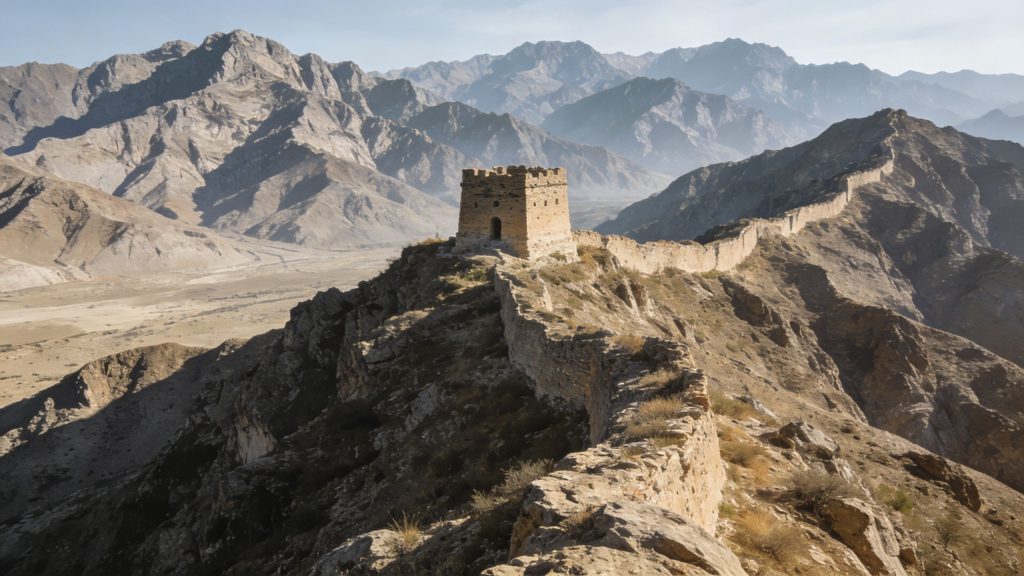
India's two principal border disputes operate on different timelines, use different instruments, and impose different demands on the state. Pakistan generates acute escalation risk centered on Kashmir, militant violence, and rapid political reaction. China imposes a slower contest over claims, patrol access, infrastructure, and military posture across a long Himalayan frontier. Together, they force India to divide attention between immediate crisis control and sustained strategic endurance.
Pakistan and the recurring Kashmir trigger
The India-Pakistan rivalry remains anchored in the unresolved status of Jammu and Kashmir. Its primary danger lies in the repeated ability of localized violence to trigger interstate escalation at speed.
The most recent example is stark. The Council on Foreign Relations conflict tracker on India and Pakistan reports that the rivalry saw its most significant escalation since 2019 after a militant attack in Pahalgam in April 2025 killed 25 Indian nationals and 1 Nepalese national. India responded with Operation Sindoor on May 6, 2025, striking nine sites in Pakistan and Pakistan-administered Jammu and Kashmir. Cross-border fire and diplomatic downgrades followed.
This pattern has strategic consequences beyond the immediate exchange. It compresses decision time for civilian leaders, amplifies public pressure for visible retaliation, and narrows the space for quiet de-escalation. In that setting, a militant incident can become a test of state credibility before either side has much room to absorb risk.
The same source notes more than 3,000 cross-border strikes in 2017 and nearly 1,000 in the first half of 2018. The Line of Control has therefore remained militarized even outside headline crises. Apparent calm can coexist with a high level of routine friction, which makes deterrence less stable than surface indicators suggest.
The Kashmir front is hazardous because everyday hostility can shorten the path from sub-conventional violence to interstate confrontation.
China and the different logic of frontier pressure
India's dispute with China follows a different logic. The main drivers are competing territorial claims, patrol encounters, road and logistics construction, and the attempt by both sides to shape facts on the ground without crossing the threshold into full war.
That distinction matters for Indian strategy. Pakistan-related crises are often event-driven and politically immediate, especially after high-casualty attacks. China-related tensions usually develop through incremental moves that test logistics, political stamina, and force readiness over time. One frontier punishes delay in crisis response. The other punishes complacency.
A concise comparison helps clarify the burden:
- Pakistan front: crisis-prone, politically charged, and vulnerable to militant triggers.
- China front: sustained, infrastructure-centered, and tied to long-term strategic competition.
- Shared requirement: both demand force availability, disciplined signaling, and sustained political attention.
The interaction between these fronts is the larger strategic issue. A Pakistan crisis can pull military assets, intelligence focus, and diplomatic effort toward the western theater just as China applies pressure in the north. A prolonged China standoff can absorb budgets and command attention that India also needs for deterrence against Pakistan. This is why border disputes cannot be treated as isolated military files. They shape India's ability to protect trade corridors, attract investment into frontier and manufacturing infrastructure, and present itself as a reliable balancing power in Asia.
For a state pursuing faster growth, supply-chain relevance, and greater diplomatic weight, contested borders impose costs well beyond defense planning. They affect risk perception, fiscal priorities, and the credibility of India's claim that it can concentrate power outward while preserving stability at home.
Mapping Internal Insurgencies and Communal Flashpoints
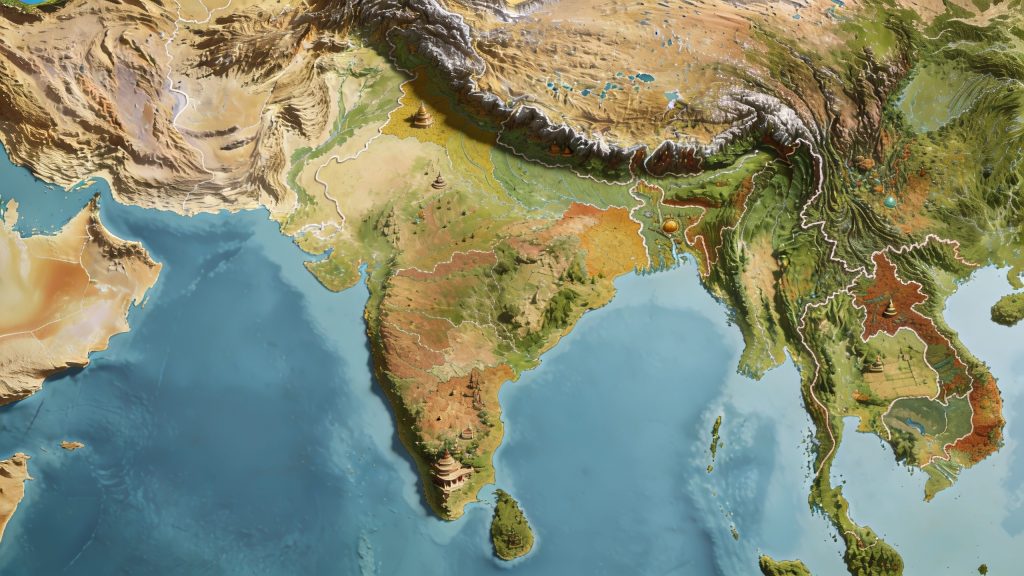
India's internal conflicts are geographically dispersed but strategically connected. Kashmir, the Northeast, Left Wing Extremist areas, and communal flashpoints arise from different histories, yet each competes for the same state capacity: intelligence focus, police strength, administrative credibility, and political attention. That competition matters because India is trying to sustain growth, deter two nuclear-armed rivals, and project reliability abroad at the same time.
The distribution of violence has never supported a single-theater view. As noted earlier, past patterns of civilian harm were spread across Jammu and Kashmir, the Northeast, and Left Wing Extremist-affected districts rather than concentrated in one zone alone. The strategic implication is straightforward. New Delhi cannot treat internal security as a subsidiary problem while managing border pressure. Domestic disorder changes force allocation, fiscal priorities, and the political room for restraint during interstate crises.
Kashmir as an internal and cross-border theater
Jammu and Kashmir remains the clearest point where domestic conflict and interstate rivalry overlap. Militancy there has drawn on local alienation, coercive counterinsurgency, and cross-border support networks. That combination gives relatively limited incidents outsized effects. A local attack can trigger national political pressure, military mobilization, and diplomatic escalation with Pakistan.
This makes Kashmir different from a conventional law-and-order problem. It is a test of whether India can maintain territorial control while preserving enough political legitimacy to prevent recurrent cycles of violence. Heavy securitization may suppress immediate threats, but if governance is seen as punitive or exclusionary, tactical gains can produce strategic drag.
The Northeast and Left Wing Extremism
The Northeast operates on a different logic. Its insurgencies have centered on ethnicity, autonomy, migration, and uneven integration with the Indian Union. Some movements have weakened through negotiated settlements and security pressure, but the region still matters because it sits on sensitive borders and on India's corridor to Southeast Asia. Instability there is not only a local governance issue. It affects connectivity plans, border management, and the credibility of India's wider regional strategy.
Left Wing Extremism poses a separate challenge. It is rooted less in secession than in rejection of state authority in areas marked by weak public services, land conflict, and poor administrative reach. That gives the conflict a stubborn quality. Police action can reduce armed activity, but state presence that arrives only through coercion does not resolve the conditions that allowed insurgent influence to take hold.
A simple comparison helps clarify the operational burden:
- Jammu and Kashmir: militancy tied to sovereignty, local legitimacy, and cross-border escalation risk.
- Northeast: insurgencies tied to identity, autonomy bargains, and borderland integration.
- Left Wing Extremist zones: insurgency tied to governance failure, rural control, and state reach.
Later in the section, this documentary background adds useful context on how these conflict geographies are often visualized and discussed:
Communal violence and political stress
Communal violence follows a different mechanism from insurgency, but its strategic effects can be just as serious. Major episodes such as the violence after the Babri Masjid demolition and the 2002 Gujarat riots showed how quickly identity-based unrest can overwhelm local policing, damage trust in institutions, and harden national political narratives. More recent official reporting on communal incidents indicates that this remains a recurring governance problem rather than a closed chapter.
The importance of communal flashpoints lies in what they do to the wider security system. They strain police forces that might otherwise be available for counterinsurgency or prevention work. They sharpen partisan incentives, which can make calibrated responses to unrest harder. They also affect India's external image at a time when New Delhi wants to be seen as a stable destination for investment and a serious balancing power in Asia.
The deeper point is systemic. Border disputes, insurgencies, and communal tensions do not sit in separate policy boxes. They reinforce one another through resource competition, political signaling, and public perceptions of state authority. If communal tensions rise during a border crisis, leaders face stronger domestic pressure to adopt rigid positions. If insurgency persists in peripheral regions, infrastructure and integration projects slow down, weakening both economic plans and strategic mobility. India's internal conflict map is therefore not only a security brief. It is a measure of how much strategic bandwidth the state has.
Key Actors and Their Strategic Drivers
India's conflict system persists because the main actors are pursuing different objectives on different timelines. States seek territorial control, deterrence, and legitimacy. Non-state groups often seek visibility, disruption, bargaining power, or ideological survival. Those incentives intersect in ways that keep violence politically useful, even when it's strategically costly.
State actors and strategic intent
The Indian state's primary driver is territorial integrity. That sounds obvious, but it has wider consequences. It pushes New Delhi to resist concession on borders, maintain a heavy security footprint in sensitive regions, and link internal order to national sovereignty.
Pakistan's incentives differ. Its strategy toward India has long depended on keeping Kashmir internationally and politically alive while imposing costs asymmetrically. In practice, that means any violence around Kashmir can have effects larger than its tactical scale. The goal is not only battlefield success. It is to shape India's threat environment, diplomatic posture, and resource allocation.
China operates on a broader strategic horizon. Its pressure on the frontier is tied to border claims, positional advantage, and regional influence. It doesn't need constant crisis. It benefits from preserving ambiguity, testing Indian responses, and forcing New Delhi to devote attention northward.
A short comparison clarifies the strategic mismatch:
| Actor | Primary Objective | Typical Method | Strategic Effect on India |
|---|---|---|---|
| India | Preserve territorial integrity and internal order | Security deployment, coercive response, political control | High readiness burden across multiple theaters |
| Pakistan | Keep Kashmir contested and impose costs asymmetrically | Proxy pressure, political signaling, cross-border friction | Recurrent crisis risk and escalatory pressure |
| China | Improve leverage along the frontier and in regional competition | Incremental military pressure, infrastructure, positional contest | Long-term force diversion and strategic distraction |
Non-state actors and the value of disruption
Non-state actors don't need to defeat the Indian state to matter. They only need to make governance expensive, legitimacy uneven, or deterrence unstable. That's why relatively small militant or insurgent formations can have strategic effects beyond their numbers.
In Kashmir, militant groups gain an advantage by collapsing the boundary between local unrest and interstate tension. In the Northeast, insurgent organizations often seek bargaining power through persistence rather than decisive victory. Maoist cadres derive relevance from operating where the state's presence is present but not fully trusted.
Their methods differ, but the logic overlaps:
- Militant networks: provoke overreaction, sustain fear, and keep contested territories politically unsettled.
- Regional insurgents: preserve organizational relevance long enough to extract concessions or autonomy arrangements.
- Ideological fighters: exploit weak governance and unequal state reach to argue that authority itself lacks legitimacy.
The central analytical point is that state and non-state strategies feed each other. Heavy force can restore order but also deepen grievance if applied indiscriminately. Political accommodation can reduce violence but may invite copycat pressure elsewhere. India's challenge isn't just defeating adversaries. It's designing responses that don't strengthen the ecosystem of conflict over time.
The Domestic and International Implications

Conflict in India has consequences far beyond the battlefield or riot zone. It shapes budget priorities, investor confidence, diplomatic alignment, and the credibility of India's claim to be both a stable growth engine and a net security contributor. For policymakers, the key point is that these effects accumulate across domains.
Why conflict management is now an economic issue
Border instability, insurgency, and communal unrest all compete with development for state attention. Even when violence is geographically concentrated, the perception of risk can travel nationally. That affects how investors judge continuity, how firms price operational uncertainty, and how partners assess India's reliability as a manufacturing and strategic hub.
This is especially important because India's rise depends on concentration. Large states gain power when they can direct political attention toward industrial upgrading, logistics, technology, and external influence. Repeated security shocks interrupt that concentration. They don't stop growth automatically, but they raise the cost of sustaining it.
For analysts who track the market transmission of geopolitical events, energy-market analysis at Vanitiro offers a useful parallel. Security crises don't stay inside the security file. They move into pricing, confidence, and political expectations.
The cyber layer is now part of crisis stability
The most important new development is that kinetic escalation and cyber escalation now move together. The Cyfirma assessment of the India-Pakistan cyber battlefield crisis reports that within roughly 48 hours of the Pahalgam attack, the daily rate of DDoS attacks against Indian sites increased 100-fold. The same reporting says Pakistan-linked hacktivist groups claimed more than 100 cyberattacks on Indian government, education, and critical-infrastructure websites in May 2025.
That matters for three reasons.
- First, crisis signaling is now multi-domain: a border flare-up no longer stays at the border.
- Second, low-cost cyber activity can amplify political pressure: disruption of public-facing systems creates media effect even without deep network penetration.
- Third, resilience planning has to merge civilian and security response: public portals, DNS resilience, and communication discipline become part of the same crisis playbook as troop movement and diplomatic signaling.
Operational implication: governments now need to treat public digital infrastructure as part of national crisis management, not as a separate technical support function.
The broader international implication is straightforward. Partners and rivals will judge India not only by how it fights, but by how well it absorbs shocks across military, civic, and digital systems. That's becoming a core test of major-power readiness.
Policy Outlook and Future Conflict Trajectories
India is unlikely to face a single decisive turning point that resolves its major conflicts at once. The more realistic path is uneven management. Some theaters may quiet temporarily. Others may flare with little warning. The policy task is to prevent one domain from igniting several others.
What to watch in the next 12 to 24 months
Analysts should monitor indicators that connect domestic and external risk rather than reading each arena in isolation.
- Border signaling: shifts in military posture, diplomatic downgrades, and harder public messaging around Kashmir remain early warning indicators of renewed India-Pakistan crisis behavior.
- Frontier infrastructure and patrol friction: on the China front, construction activity, access restrictions, and changes in local military behavior matter more than rhetoric alone.
- Internal legitimacy signals: communal mobilization, policing controversies, and governance failures in sensitive regions can create conditions that external adversaries exploit.
- Digital crisis readiness: attacks on public-facing systems during political or military shocks should now be read as part of escalation management, not background noise.
A wider regional lens also helps. Readers following Vanitiro's coverage of the Houthi Red Sea attacks will recognize a broader lesson. Modern conflict spreads through chokepoints, narratives, and infrastructure layers faster than many bureaucracies adapt.
The strategic test for India
India's long-term success won't depend only on deterring Pakistan or balancing China. It will depend on whether the state can reduce the interaction effects among its conflicts. That means preventing communal tensions from corroding legitimacy, preventing internal insurgencies from becoming permanent governance substitutes, and preventing border crises from repeatedly hijacking national strategy.
The strongest policy approach is a layered one. Keep deterrence credible on disputed borders. Preserve political channels in internal conflict zones. Build faster protection for civilian-facing digital systems. Most important, treat domestic cohesion as a hard security variable rather than a soft social issue.
Conflict in India is often described as a set of separate fronts. That understates the problem. India is managing an integrated security system in which border disputes, insurgency, communal tension, and cyber disruption reinforce one another. A state that wants global influence has to break those linkages faster than its adversaries can exploit them.
Vanitiro tracks the kind of cross-domain risk this analysis depends on: conflict, diplomacy, sanctions, cyber escalation, and the economic spillovers that follow. If you want concise, sourced geopolitical briefings that connect security events to markets and policy, follow Vanitiro.